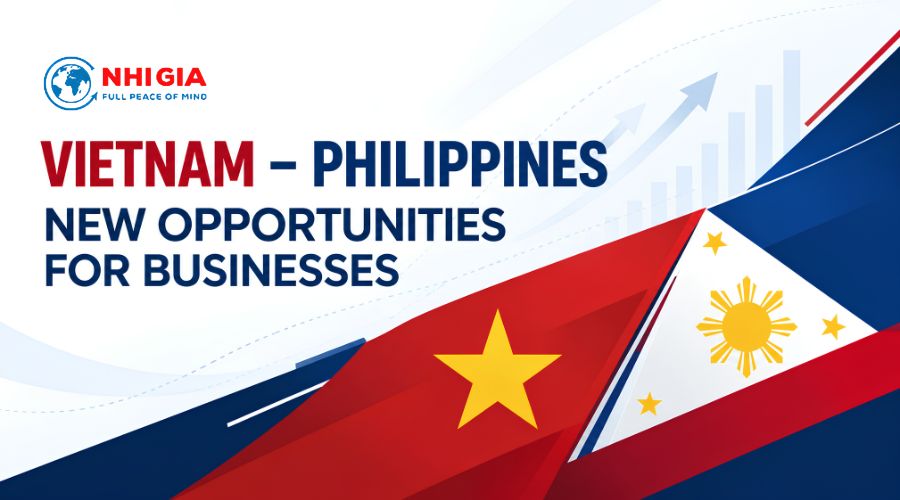
After 50 years of diplomatic relations, economic cooperation between Vietnam and the Philippines has continued to develop, especially in trade, investment, agriculture, industry, digital economy, and business connectivity. This serves as an important foundation for businesses from both countries to expand markets, seek partners, and promote trade activities in the new period.
According to Vietnamese Ambassador to the Philippines Lai Thai Binh, economic cooperation has always been an important pillar in bilateral relations, reflecting the development needs of each country and contributing to peace, stability, and shared prosperity in the region.
Vietnam – Philippines economic cooperation continues to grow
Over the years, bilateral trade between Vietnam and the Philippines has maintained positive growth. During the 2015–2025 period, two-way trade turnover increased from USD 2.92 billion to USD 7.8 billion, with an average growth rate of over 10% per year.
In the first five months of 2026 alone, bilateral trade reached USD 3.74 billion. Vietnam’s exports to the Philippines reached USD 2.70 billion, showing that the Philippines remains one of Vietnam’s important markets in ASEAN.
Notably, the Philippines is Vietnam’s largest rice export market, accounting for around 40% of Vietnam’s total rice exports. At the same time, Vietnamese rice accounts for about 85% of the Philippines’ rice imports, making an important contribution to the country’s food security. In addition, the Philippines has strong demand for many Vietnamese products such as agricultural products, construction materials, cement, steel, electronic components, and consumer goods.
Two-way investment continues to expand
In addition to trade, investment between Vietnam and the Philippines has also recorded positive developments.
As of the end of April 2026, the Philippines had 112 valid projects in Vietnam with total registered capital of over USD 626.8 million. Several Philippine brands, such as Jollibee and Oishi, have become familiar to Vietnamese consumers.
In the opposite direction, Vietnam had 25 investment projects in the Philippines with total registered capital of more than USD 148.2 million. In 2025 alone, Vietnam’s investment in the Philippines reached around USD 92 million. New projects in transportation services, green energy, and modern service sectors show that Vietnamese businesses are gradually shifting from commercial presence to building product ecosystems, service networks, and value chains in the host market.
Tourism and air connectivity become bright spots
After the COVID-19 pandemic, air connectivity and tourism between Vietnam and the Philippines have emerged as new bright spots. Expanded direct flights have made it more convenient for people, businesses, and localities from both sides to exchange, cooperate, and travel for business purposes.
The number of Philippine visitors to Vietnam has increased more than fourfold in less than a decade, from 110,967 arrivals in 2016 to 482,173 arrivals in 2025. In the first four months of 2026 alone, Vietnam welcomed around 236,000 Philippine visitors, up 73.4% year-on-year, helping the Philippines enter Vietnam’s top 10 inbound tourism markets for the first time.
This growth not only promotes tourism, but also creates favorable conditions for market research, trade fair participation, partner meetings, contract signing, and business cooperation expansion.
Upgraded relations open more opportunities for businesses
During the State visit to the Philippines by General Secretary and State President To Lam from May 31 to June 1, 2026, the two countries issued a Joint Statement upgrading their relations to an Enhanced Strategic Partnership. This historic milestone makes Vietnam the only ASEAN country to establish an Enhanced Strategic Partnership framework with the Philippines.
The new cooperation framework is expected to create further momentum for economic, trade, and investment cooperation between the two countries, with the goal of bringing bilateral trade turnover beyond USD 10 billion in a more balanced and sustainable manner.
For businesses, this is an opportunity to strengthen partner connections, expand distribution channels, seek supply sources, implement investment projects, and participate more deeply in regional supply chains.
Potential areas of cooperation in the coming period
In addition to traditional sectors, Vietnam – Philippines cooperation is expanding into many new areas.
Three fields are expected to create breakthroughs in bilateral economic cooperation in the coming period:
1. Digital economy and e-commerce
Both Vietnam and the Philippines have young populations, rapid digital transformation, and strong demand for payment solutions, logistics, digital platforms, and e-commerce.
2. Renewable energy and green economy
The Philippines is promoting solar and wind energy development while reducing dependence on fossil fuels. This creates notable cooperation opportunities for businesses with experience in energy and green technology.
3. Agriculture, fisheries, and deep-processed food
Growing consumer demand in major Philippine cities such as Metro Manila, Cebu, and Davao is opening more opportunities for Vietnamese processed food, seafood, Halal products, and consumer goods.
What should businesses prepare when expanding Vietnam – Philippines cooperation?
As Vietnam – Philippines economic cooperation continues to be promoted, Vietnamese businesses have more opportunities to seek partners, conduct market research, attend trade fairs, sign contracts, or implement projects in the Philippines. However, to ensure smooth cooperation, businesses need to prepare carefully in terms of market information, legal documents, and business travel plans.
Businesses should proactively verify the credibility of partners before signing contracts or conducting transactions. Information such as legal status, operating history, financial capacity, import or distribution experience should be carefully checked to limit risks during cooperation.
For business trips to the Philippines, companies should prepare complete documents such as invitation letters, working schedules, business trip assignment decisions, company legal documents, documents proving the purpose of the trip, and other materials related to the cooperation between both parties.
In addition, if businesses participate in trade fairs, conduct market research, or negotiate contracts, preparing a company profile, product catalogue, quotation, contract sample, capability documents, and a clear working plan is also important to demonstrate professionalism to international partners.
Nhị Gia accompanies businesses in Vietnam – Philippines international cooperation
As Vietnam – Philippines cooperation continues to expand in trade, investment, agriculture, logistics, tourism, digital economy, and green energy, the need for business travel and international documentation support for companies from both countries is becoming increasingly clear. Businesses not only need to find the right partners, but also need to prepare the right documents to effectively carry out cooperation, market research, event participation, or contract signing.
Nhị Gia supports businesses in reviewing, preparing, and completing documents related to international activities. Services may include overseas business visas for Vietnamese entrepreneurs, Vietnam visas for foreigners, work permits, work permit exemption confirmations, temporary residence cards, consular legalization, consular certification, notarized translation, and corporate flight tickets.
With experience serving corporate clients, Nhị Gia accompanies businesses in checking application conditions, reviewing required documents, and advising suitable solutions for each specific case. This helps businesses become more proactive when cooperating with Philippine partners.
Reference sources: Ministry of Industry and Trade, Nhan Dan Newspaper.