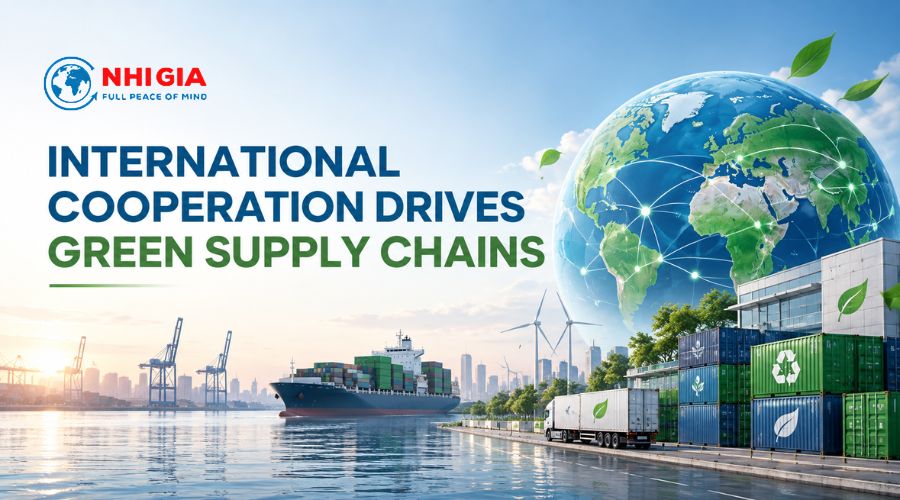
International cooperation is becoming one of the key drivers of Vietnam’s green transition. Through cooperation programmes in technology, climate finance, clean energy, and sustainable development governance, businesses have greater opportunities to upgrade their production activities, reduce emissions, and participate more deeply in global supply chains.
This is not only an important source of support for Vietnam in achieving its net-zero emissions target by 2050, but also an opportunity for businesses to build new competitive advantages as markets increasingly prioritise environmental, social, and governance standards.
Global supply chains are shifting towards green standards
In many manufacturing and export sectors, price and supply capacity are no longer the only criteria used to select business partners.
Corporations, importers, and investment funds are paying increasing attention to suppliers’ ability to control emissions, ensure traceability, use energy efficiently, protect the environment, and fulfil their social responsibilities.
As a result, green transition requirements are becoming embedded throughout supply chains. Businesses seeking to retain orders, expand into new markets, or join the supply networks of international corporations must gradually improve operational transparency and comply with sustainable development standards.
The Vietnamese Government has also identified businesses as a decisive force in the country’s journey towards net zero. Emissions reduction must be linked to the transformation of growth models and improvements in the environmental, social, and governance standards of Vietnamese products within global supply chains.
What opportunities does international cooperation provide?
1. Access to Technology and Management Expertise
Through cooperation with international organisations, businesses can gain access to energy-efficient production technologies, renewable energy, energy storage systems, waste-treatment solutions, and circular economy models.
In addition to equipment and technology, businesses also have opportunities to learn from international experience in emissions management, environmental data development, and the application of global standards to production activities.
Technology transfer must be accompanied by operational capacity, workforce training, and adjustments to internal processes. These are essential conditions for new technologies to deliver genuine value rather than becoming costly investments that are difficult to operate sustainably over the long term.
2. Greater access to green finance
Technology transformation, production-line improvements, and emissions-reduction projects all require significant capital. Green finance and supply-chain finance are therefore becoming increasingly important components of international cooperation.
In 2025, the International Finance Corporation and the Swiss State Secretariat for Economic Affairs continued implementing a supply-chain finance programme in Vietnam. The programme aims to help more than 500,000 small and medium-sized enterprises gain access to up to USD 35 billion in working capital.
This financing may help businesses improve cash flow, invest in equipment, upgrade management systems, and better meet the requirements of customers within supply chains.
However, to access international financing, businesses need transparent financial statements, feasible capital-use plans, and the ability to demonstrate the environmental effectiveness of their projects.
3. Deeper participation in global supply chains
International cooperation enables businesses to connect with buyers, investors, financial institutions, and technology partners worldwide.
Businesses that can demonstrate stable production capacity, transparent information, and a strong commitment to sustainable development are more likely to become suppliers to major corporations.
However, opportunities do not automatically translate into orders. Businesses must proactively strengthen their production capacity, establish quality-control systems, and standardise data to meet the due-diligence requirements of international partners.
4. Access to carbon instruments and markets
The development of carbon markets provides additional incentives for businesses to measure and proactively reduce emissions.
On 29 June 2026, the Vietnam Carbon Exchange was launched, helping establish a more transparent trading mechanism and providing businesses with additional tools to optimise emissions-reduction costs.
Businesses that prepare emissions data early will have an advantage when participating in the carbon market, preparing sustainability reports, or working with partners that require information on the carbon footprint of products.
What should small and medium-sized enterprises prepare?
For small and medium-sized enterprises, the green transition does not necessarily need to begin with a large-scale project. Businesses can implement gradual changes based on their actual resources.
First, businesses should review their current consumption of electricity, water, raw materials, and fuel. Areas that consume significant resources or generate large volumes of waste should be prioritised for improvement.
Next, businesses should standardise production data, raw-material origins, supplier information, and environmental management processes. Reliable data is essential for demonstrating capability to customers, banks, and investors.
Businesses should also develop a phased transition roadmap, identifying actions that can be implemented immediately and those that require additional capital or technological support.
For the 2026–2030 period, Vietnam aims to support approximately 25,000 businesses, household businesses, and cooperatives in developing sustainable business activities. This demonstrates that the support ecosystem for corporate green transition continues to expand.
Transparency is the foundation of sustainable cooperation
Within green supply chains, trust is built not only through commitments but also through data and measurable results.
International partners need to understand which raw materials a business uses, whether its production processes are properly controlled, how emissions are calculated, and what results have been achieved through improvement measures.
Businesses should therefore avoid announcing numerous targets without clear implementation plans. Instead, they should select commitments that match their capabilities, establish measurable indicators, and monitor progress regularly.
When information is transparent, businesses not only strengthen their credibility but also improve their ability to access financing, identify suitable partners, and participate in higher-value supply chains.
Proactive transformation to avoid missing opportunities
International cooperation is creating additional opportunities in technology, finance, market access, and management expertise. However, businesses can only make effective use of these resources if they are adequately prepared to receive and implement them.
Green transition should therefore not be viewed merely as an additional cost. It is a process that enables businesses to use resources more efficiently, reduce risks, strengthen trust with partners, and build long-term competitive advantages.
The earlier businesses begin, the more time they will have to improve processes, standardise data, and adapt to evolving market requirements.
Does your business want to strengthen its ability to participate in green supply chains? Proactively review your operations, standardise your data, and develop a transition roadmap today. Contact our consulting team for an assessment of your current readiness and guidance on solutions suited to your business size, industry, and available resources.
Reference source: Bao Moi