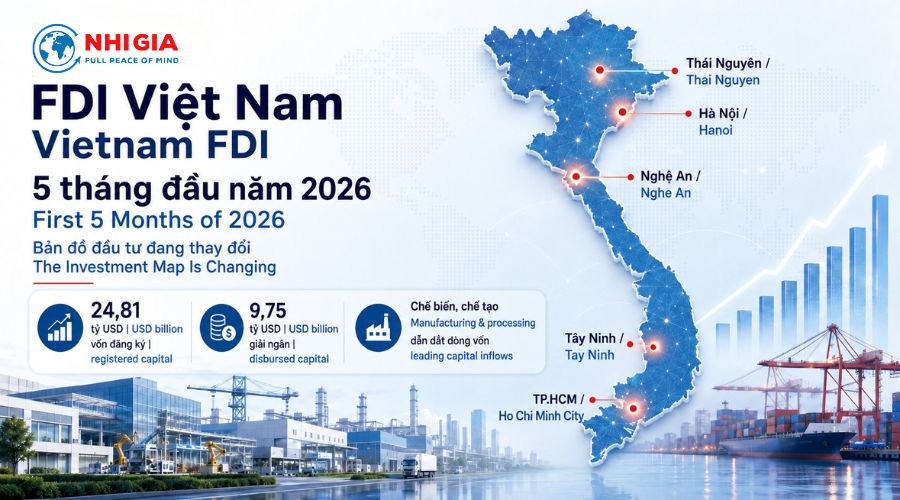
Vietnam’s foreign direct investment continued to show strong momentum in the first five months of 2026. Registered foreign investment reached USD 24.81 billion, up 34.9% year-on-year. More importantly, disbursed FDI reached USD 9.75 billion, up 9.6% and the highest five-month level recorded in recent years.
The structure of investment is also becoming clearer. Vietnam’s FDI story remains strongly manufacturing-led. Among newly licensed projects, manufacturing and processing attracted USD 9.64 billion, accounting for 65.0% of newly registered capital. If new and adjusted capital are combined, manufacturing reached around USD 14.52 billion, representing more than 70% of total new and adjusted capital.
These figures show that Vietnam remains a key destination in global supply chain restructuring. However, the FDI map is changing. Investment is no longer concentrated only in traditional hubs such as Ho Chi Minh City, Hanoi, Bac Ninh, Binh Duong and Dong Nai. A new pattern is emerging, with large investors looking more closely at provinces that can offer clean industrial land, competitive labour costs, better infrastructure readiness and faster administrative support.
For foreign-invested companies, this shift is not only about where capital is going. It also affects how companies plan their people, documentation and long-term presence in Vietnam.
Vietnam’s FDI growth is becoming more manufacturing-led
Manufacturing and processing continue to play a central role in Vietnam’s FDI attraction. This is not surprising. Vietnam has become an important manufacturing base for electronics, components, textiles, machinery, consumer goods, industrial products, food processing and supporting industries.
When manufacturing FDI grows, the impact goes beyond factory construction. Each project can create demand for industrial land, ready-built factories, warehouses, logistics services, suppliers, technical labour, foreign experts, plant managers and operational teams.
For large-scale projects, foreign investors often need to send people to Vietnam at different stages: market research, site selection, legal setup, construction, machinery installation, testing, training, production ramp-up and long-term management. These people may include investors, regional executives, engineers, technical specialists, quality control experts, project managers and senior managers.
This means that manufacturing-led FDI naturally creates demand for immigration, labour and residence documentation. A company may begin with an investment plan, but once the project moves into implementation, it must also manage visas, work permits, temporary residence cards and overseas-issued documents for foreign personnel.
The FDI map is expanding beyond traditional hubs
For many years, Vietnam’s FDI map was strongly associated with major economic centres and industrial provinces such as Ho Chi Minh City, Hanoi, Bac Ninh, Binh Duong, Dong Nai and Hai Phong. These areas developed early advantages in infrastructure, industrial parks, labour supply, logistics and supplier networks.
However, as costs rise and land availability becomes more limited in some established hubs, investors are increasingly looking at new locations. Large manufacturing projects need more than a convenient address. They need clean land, room for expansion, reliable infrastructure, labour availability, administrative support and long-term operating conditions.
This is why provinces such as Thai Nguyen, Nghe An, Tay Ninh, Phu Tho and Ha Tinh are becoming more visible on Vietnam’s national FDI map. These locations may not all be traditional FDI centres, but they can offer the scale and development space required for new manufacturing campuses.
For investors, this means Vietnam should increasingly be viewed as a wider industrial network rather than a few familiar locations. For service providers, industrial parks and local authorities, it means competition for FDI will depend on readiness, speed and the ability to support complex projects.

Why investors are looking at emerging industrial provinces
Large investors usually evaluate a location based on the full operating environment, not only land cost. They consider industrial land availability, infrastructure, electricity, water, logistics access, labour supply, administrative procedures, supplier networks and the ability to scale.
For billion-dollar manufacturing campuses or large industrial projects, expansion potential matters. A company may need not only one factory, but also space for future production lines, warehouses, employee facilities, suppliers and supporting services.
Emerging industrial provinces can become attractive when they offer a combination of land availability, competitive cost and improved infrastructure. Some provinces are also actively improving administrative support to attract large projects and move up the investment value chain.
This trend has practical implications. As foreign investors enter new provinces, they may need more on-the-ground support for business setup, site visits, factory development, personnel movement and local compliance.
Foreign investors need stronger on-the-ground presence in Vietnam
When FDI projects expand into new provinces, foreign investors and experts often need to be physically present in Vietnam more often. A manufacturing project usually involves several stages: site visits, industrial park discussions, investment documentation, contract negotiation, design, construction, equipment import, installation, testing, recruitment, training and commercial operation.
At each stage, different foreign personnel may be involved. Investors or legal representatives may come for negotiations and decision-making. Project managers may coordinate implementation. Technical experts may support machinery installation, technology transfer or training. Senior managers may stay longer to run the factory or regional operation.
As a result, FDI growth does not only create demand for industrial land and factories. It also creates demand for Vietnam visas, work permits, temporary residence cards and cross-border documentation.
This is especially important for companies that plan to send foreign personnel to Vietnam repeatedly or for long-term assignments. Immigration and labour documentation should be part of the project plan, not a separate administrative task handled at the last minute.
From manufacturing FDI to work permit demand
Foreign experts play an important role in many FDI manufacturing projects. They may be responsible for production line setup, machinery operation, quality control, automation, plant management, safety, logistics, supplier development or technical training.
If a foreign expert directly works in Vietnam, the company should review whether a work permit or work permit exemption confirmation is required under the applicable regulations. This process often requires documents showing the person’s position, qualifications, experience, appointment, working location and sponsoring company.
Professional documents are often critical. Degrees, certificates, experience letters, appointment decisions, criminal record checks and other overseas-issued documents may need consular legalization and certified translation before they can be used in Vietnam.
For large projects, work permit planning should begin before the expert arrives. If companies wait until the technical team is ready to enter Vietnam, delays in documentation may affect installation, commissioning, training or production timelines. And because apparently machines do not patiently wait for paperwork to catch up, timing matters.
Temporary residence cards for investors, managers and foreign experts
When an FDI project moves from setup to operation, many foreign investors, legal representatives, factory directors, technical experts or senior managers may need to stay in Vietnam for longer periods. In such cases, a temporary residence card may become relevant.
A temporary residence card allows eligible foreigners to reside in Vietnam for a certain period under the appropriate category. For FDI companies, it can support a more stable working and living arrangement for foreign personnel who need to manage projects, oversee operations or travel in and out of Vietnam for business purposes.
Depending on the case, a temporary residence card may be linked to investment status, work permit, work permit exemption confirmation, company sponsorship, family relationship or another eligible basis. This is why companies should look at the full documentation chain: entry visa, work permit or exemption, temporary residence card, passport validity, sponsor documents and residence registration.
If family members accompany foreign personnel, additional documents such as marriage certificates or birth certificates may be required. If these documents are issued overseas, legalization and certified translation may also be needed.
Cross-border documents in FDI projects
FDI projects often involve many documents issued outside Vietnam. These may include parent company registration documents, charters, board resolutions, appointment letters, powers of attorney, financial statements, contracts, professional certificates, degrees, experience confirmations, criminal record checks and family documents.
If these documents are used in Vietnam, companies should check whether consular legalization and certified translation are required. This step can significantly affect the timeline if it is not prepared early.
For example, a foreign expert’s degree or experience letter may be needed for a work permit file. A marriage certificate or birth certificate may be needed for a dependent’s residence file. A parent company document, appointment decision or power of attorney may be needed for corporate, investment or personnel documentation.
For FDI projects involving multiple contractors, suppliers or foreign personnel, cross-border document management should have a clear owner. A missing legalization step, inconsistent personal information or inaccurate translation can create unnecessary delays.
What should FDI companies prepare when expanding in Vietnam?
FDI companies should prepare two tracks at the same time: project documentation and foreign personnel documentation. Project documentation relates to investment, location, industrial parks, contracts, corporate records and operational requirements. Foreign personnel documentation relates to visas, work permits, temporary residence cards and professional documents.
Companies should create a list of foreign personnel expected to enter Vietnam at each project stage: site visits, negotiation, construction, installation, testing, training and operation. For each person, the company should identify the role, working duration, working location, sponsoring entity and required documents.
Companies should also review overseas-issued documents early to determine which ones need consular legalization, certified translation or updated copies before submission in Vietnam.
For projects involving multiple experts, contractors or senior managers, companies should maintain a tracking system for passport validity, visas, work permits, temporary residence cards, contracts, appointment letters and family documents. This helps reduce disruption during key implementation milestones.

How Nhi Gia supports FDI companies in Vietnam
As Vietnam’s FDI map changes and manufacturing investment expands into more provinces, foreign-invested companies need more than industrial land and factory planning. They also need to manage the documentation of investors, experts, managers and foreign personnel working in Vietnam.
Nhi Gia supports FDI companies, foreign investors and foreign professionals with documentation and mobility services related to international business activities in Vietnam. These services may include Vietnam visa support for foreigners, work permits, work permit exemption confirmation, temporary residence cards, consular legalization, certified translation, outbound business visa support and corporate air ticketing.
With experience serving corporate clients, Nhi Gia assists companies in reviewing document requirements, preparing supporting files and coordinating suitable solutions based on each specific case. This helps businesses stay more proactive when receiving foreign experts, relocating international staff and implementing FDI projects across Vietnam.
Frequently asked questions about Vietnam FDI and foreign personnel documentation
Why does Vietnam’s FDI growth increase demand for foreign personnel documentation?
As FDI grows, especially in manufacturing, more projects require investors, engineers, managers and technical experts to enter Vietnam for site visits, installation, training, operation and project management. This creates demand for visas, work permits, temporary residence cards and related legal documents.
Do foreign experts in FDI projects need a work permit?
If a foreign expert directly works in Vietnam, the company should review whether a work permit or work permit exemption confirmation is required based on the role, working duration and applicable regulations.
Can foreign investors apply for a temporary residence card in Vietnam?
Foreign investors may be eligible for a temporary residence card under the appropriate category if they meet the required conditions related to investment status, visa type, sponsorship and residence purpose.
Do parent company documents need legalization for use in Vietnam?
Overseas-issued parent company documents may need consular legalization and certified translation before being used in Vietnam, depending on the document type and purpose.
When should FDI companies prepare foreign personnel documentation?
FDI companies should prepare foreign personnel documentation during the project planning stage, before foreign experts or managers enter Vietnam. Early preparation helps avoid delays during site visits, installation, testing, training and operation.
Sources: UK in Vietnam; Ministry of Industry and Trade of Vietnam; UK Export Finance; Government News; updates on UK-Vietnam trade, education and energy cooperation in 2026.