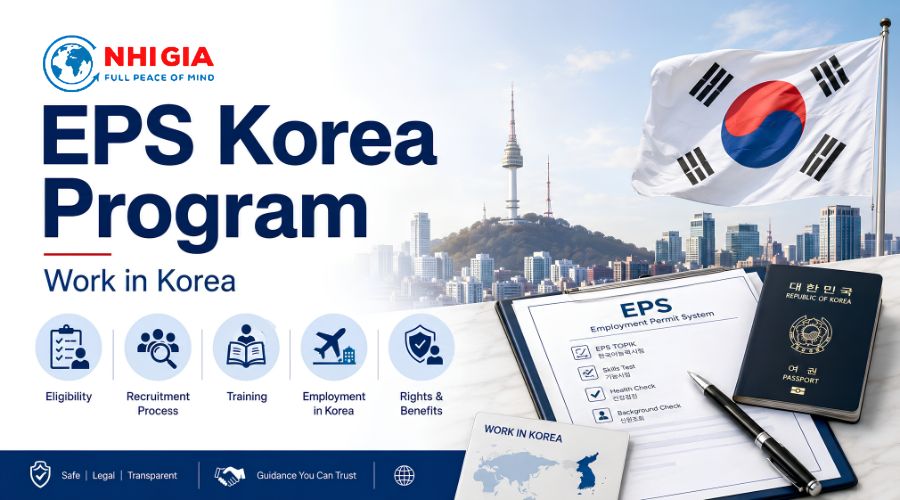
The Employment Permit System, commonly known as EPS, is one of the official channels for Vietnamese workers seeking lawful employment opportunities in South Korea. Over the years, however, the issue of Vietnamese workers overstaying and remaining illegally in South Korea has led to temporary recruitment suspension for certain localities in Vietnam during specific periods.
In the past, some articles referred to lists of provinces, districts or localities that were “banned” or temporarily suspended from sending workers to South Korea under the EPS program. These lists were issued for specific years and should not be used as a basis for current recruitment rounds.
For 2026, workers should refer to official announcements from the Center of Overseas Labor and competent local authorities to check eligibility requirements, recruitment sectors, quotas, Korean language test schedules, skills test requirements and other relevant conditions.
What is the EPS program?
EPS is South Korea’s Employment Permit System for foreign workers. For Vietnamese workers, the program is implemented under the official cooperation framework between the competent authorities of Vietnam and South Korea.
Through the EPS program, eligible Vietnamese workers may register for selection to work in South Korea in sectors announced by the Korean side each year or each recruitment round.
According to the 2026 recruitment plan, Vietnamese workers are recruited for the following sectors:
- Manufacturing;
- Fisheries;
- Forestry;
- Services.
Workers should note that registration, participation in the Korean language test or completion of the skills test does not guarantee employment in South Korea. A worker may only depart for South Korea after meeting all requirements, passing the required selection stages, being selected by a Korean employer, signing an employment contract and completing all required procedures.
Is there a list of localities suspended from EPS recruitment in 2026?
According to the 2026 EPS recruitment announcements published by the Center of Overseas Labor, the main contents focus on recruitment quotas, eligible sectors, registration requirements, Korean language test schedules, skills tests and participation procedures.
At the time of this article update, Nhi Gia has not recorded an official list of provinces, districts or localities subject to EPS recruitment suspension in 2026 in the form of a fixed locality list similar to some previous years.
Therefore, workers should not rely on outdated lists from 2018, 2019 or previous years to determine whether they are eligible to register for the EPS program in 2026. If any list of suspended localities is issued, it should be checked against the latest official announcements from the Center of Overseas Labor and competent local authorities.
Workers are advised to verify official information before registration, especially in the following cases:
- Their place of permanent residence was previously included in a suspended locality list;
- They previously worked, stayed or violated residence regulations in South Korea;
- They have family members illegally staying in South Korea;
- They register for a sector with additional requirements on place of residence or work experience;
- There are changes in their identity documents, household registration, permanent residence or personal information.
Checking eligibility before registration helps workers reduce the risk of application rejection, unnecessary costs or incorrect preparation based on outdated information.
Why were some localities previously suspended from EPS recruitment?
In previous periods, certain localities in Vietnam were temporarily suspended from EPS recruitment due to a high number or rate of workers who failed to return to Vietnam after their employment contracts expired and continued staying illegally in South Korea.
Temporary recruitment suspension is generally intended to:
- Reduce the number of Vietnamese workers illegally staying in South Korea;
- Encourage workers and their families to comply with employment contracts;
- Strengthen local responsibility in communication and management;
- Protect the reputation of Vietnamese workers in the Korean labor market;
- Maintain long-term labor cooperation opportunities between Vietnam and South Korea.
Temporary suspension should not be understood as a permanent ban. The list of suspended localities may change from year to year depending on the actual situation and the reduction of illegal stay rates in South Korea.
Can workers from previously suspended localities register for EPS?
Workers from localities that were previously suspended may still be eligible to register for the EPS program if their locality is no longer subject to suspension under the latest official announcement.
Before registration, workers should carefully check:
- Whether their place of permanent residence is suspended in the current recruitment round;
- Whether the selected sector has specific locality-related requirements;
- Whether they fall under any restriction from participating in the EPS program;
- Whether they have family members illegally staying in South Korea;
- Whether they have previously overstayed, been deported or violated Korean residence regulations.
In some cases, registration requirements may vary by sector. Workers should therefore read the official recruitment notice for each round carefully and avoid relying on word-of-mouth information or outdated online articles.
Eligibility requirements for EPS Korea 2026
Specific requirements may vary depending on each recruitment round and sector. In general, workers are usually required to meet the following basic conditions:
- Being within the eligible age range stated in the recruitment notice;
- Having no criminal record or not falling under restricted cases;
- Not being prohibited from exiting Vietnam;
- Not being prohibited or restricted from entering South Korea;
- Being medically fit to work in South Korea;
- Not having specified family members illegally staying in South Korea;
- Not having overstayed, been deported or violated residence regulations in South Korea, unless an exception or specific policy applies;
- Meeting additional requirements for the registered sector, if any.
In addition, workers need to take the EPS-TOPIK Korean language test, skills test and competency assessment according to the recruitment plan. Passing the required tests only allows workers to submit an application for selection. It does not guarantee that they will be selected by a Korean employer.
EPS recruitment sectors in 2026
According to the 2026 recruitment plan, the EPS program recruits Vietnamese workers in the following main sectors:
Manufacturing
Manufacturing is one of the most common sectors under the EPS program. Workers may be employed in factories, production lines or manufacturing facilities in South Korea. Applicants should meet health, discipline and sector-specific requirements stated in the recruitment announcement.
Fisheries
The fisheries sector usually requires workers to have good health and the ability to work in marine, fishing, aquaculture or seafood-related environments. Due to the specific nature of the work, applicants should carefully consider the working conditions before registration.
Forestry
The forestry sector may involve work related to planting, caring for, harvesting or processing forestry products according to recruitment needs in South Korea. Workers should check the applicable health, experience and additional requirements, if any.
Services
The services sector is recruited based on the quota and specific requirements of each year. Workers should carefully review official announcements for details on job categories, registration conditions, examination content and competency assessment requirements.
Basic process for participating in the EPS program
The EPS process generally includes the following steps:
Step 1: Follow official recruitment announcements
Workers should monitor announcements from the Center of Overseas Labor and competent local authorities regarding recruitment sectors, registration periods, application receiving locations, examination requirements and registration fees.
Step 2: Check personal and locality-based eligibility
Before registration, workers should check whether they meet the requirements regarding age, health, personal background, previous stay in South Korea, family members in South Korea and place of permanent residence.
Workers who do not meet the requirements may be rejected at later stages, resulting in wasted time and costs.
Step 3: Register for the EPS-TOPIK Korean language test
Workers register for the test according to the time, location and method stated in the announcement. At registration, they must provide accurate information, prepare valid identification documents and pay the required fee.
Step 4: Take the Korean language test and skills test
Workers take the Korean language test and skills test according to the announced schedule. Certain sectors may require additional competency assessment, work experience, certificates or other supporting conditions.
Step 5: Submit the application for selection
Workers who pass the required tests will be guided to submit an application for selection so that their profiles may be introduced to Korean employers.
Step 6: Sign the employment contract and complete departure procedures
After being selected by a Korean employer, the worker will proceed with the employment contract, orientation training, required financial obligations and other departure procedures.
Important notes when registering for EPS Korea
When learning about or registering for the EPS program, workers should note the following:
- Follow information only from official sources;
- Do not pay money to unauthorized individuals or organizations;
- Do not trust promises of guaranteed selection, guaranteed departure or fast-track placement;
- Do not forge documents, certificates, work experience or personal information;
- Do not allow someone else to register, take the test or use documents on their behalf;
- Check whether their place of permanent residence is suspended in the current recruitment round;
- Comply with the employment contract and return to Vietnam on time after the work period ends.
Illegal stay in South Korea does not only affect the individual worker. It may also affect opportunities for other workers from the same locality to participate in the EPS program.
Should workers use consulting support when preparing for EPS?
The EPS program is implemented under the official cooperation mechanism between Vietnam and South Korea. Workers should note that not every individual or organization is authorized to send workers to South Korea under the EPS program.
In practice, however, workers and their families may need consultation to understand eligibility requirements, review personal documents, prepare supporting documents, distinguish official information from unreliable information and identify potential fraud risks.
If workers use consulting support, they should choose a transparent service provider that gives clear guidance, does not make improper guarantees and does not collect fees contrary to the instructions of the competent authorities.
How can Nhi Gia support workers and families?
With experience in visa, consular documentation and international mobility procedures, Nhi Gia supports clients in reviewing information, advising on documents and providing case-specific guidance.
For workers and families learning about the EPS program for South Korea, Nhi Gia may support with:
- Explaining EPS requirements and participation conditions;
- Guiding clients on how to check official announcements;
- Reviewing personal information, passport and identity documents;
- Advising on common risks during document preparation;
- Helping distinguish official information from unreliable information;
- Advising on visa, consular or related documentation where clients have other legitimate international mobility needs.
For consultation on document review, eligibility checking or international mobility procedures related to South Korea, please contact Nhi Gia for detailed support.