Proof of financial capacity is an important requirement in many visa applications, including tourist visas, family visit visas, business visas, student visas and certain long-term stay applications. Through financial documents, the consular authority can assess whether the applicant has sufficient funds for the trip, a reasonable source of income and financial ties to their country of residence.
Depending on the destination country, visa purpose and the applicant’s circumstances, financial requirements may vary. Therefore, financial documents should be prepared carefully, transparently and in line with the purpose of travel.
What is proof of financial capacity?
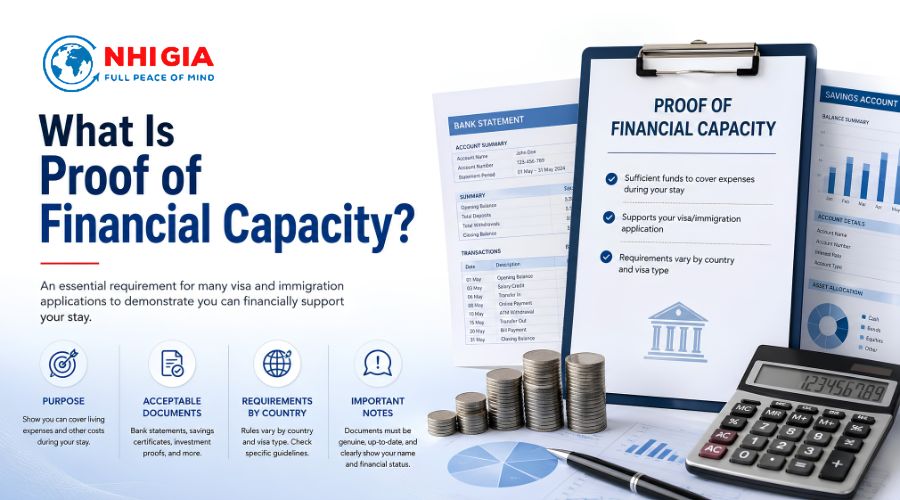
Proof of financial capacity refers to the documents submitted by a visa applicant to demonstrate their financial ability, income, assets and capacity to cover expenses during their stay abroad.
Financial documents are commonly used to show that:
- The applicant has sufficient funds to cover travel, accommodation, living, study or other expenses abroad;
- The funds are supported by a reasonable source, such as salary, business income, assets or other lawful income;
- The applicant has financial stability in Vietnam;
- The stated purpose of travel is consistent with the visa application;
- The applicant has sufficient ties to return to Vietnam after the permitted stay, especially in short-term visa applications.
Proof of financial capacity is not limited to submitting a savings account or bank balance confirmation. A strong financial profile should demonstrate consistency between available funds, income sources, transaction history, employment, assets and the intended purpose of travel.
Why is proof of financial capacity required for visa applications?
Many countries require financial documents to assess the applicant’s ability to pay for the trip and the credibility of the visa application. It is one of the factors used by consular authorities to determine whether the applicant is likely to enter the country for the stated purpose.
Proof of financial capacity is generally used to:
- Confirm that the applicant can afford the trip;
- Assess the ability to pay tuition and living expenses in student visa cases;
- Review the consistency between income, assets and travel plans;
- Evaluate financial, employment or asset ties in Vietnam;
- Reduce the risk of misuse of visa, overstay or unauthorized employment in the destination country.
For tourist or family visit visas, financial documents help demonstrate that the applicant can pay for the trip. For student visas, the applicant or sponsor must usually demonstrate the ability to cover tuition fees and living costs. For business or event-related visas, financial responsibility may rest with the applicant, the company in Vietnam or the inviting organization abroad, depending on the case.
What documents are used to prove financial capacity?
Financial requirements vary by country. In general, financial documents usually fall into three main groups: bank deposits, income documents and asset ownership documents.
Savings account or bank balance confirmation
A savings account or bank balance confirmation is one of the most common documents used to prove financial capacity in visa applications.
Common documents include:
- Savings account book or certificate;
- Bank balance confirmation;
- Bank statements for a specific period;
- Fixed deposit confirmation;
- Current account statements showing stable cash flow.
There is no single amount that applies to all visa applications. The appropriate amount depends on the destination country, length of stay, purpose of travel, itinerary, estimated expenses and the applicant’s personal circumstances.
For example, a short-term tourist visa usually requires a different level of financial proof compared to a long-term student visa. A solo traveler may also be assessed differently from a family group. Where a financial sponsor or paying organization is involved, the application should clearly demonstrate the relationship and financial capacity of the sponsor.
Income documents
In addition to the available balance, the source of funds is often an important consideration. Income documents help explain how the funds were accumulated.
Common income documents include:
- Employment contract;
- Appointment decision or employment confirmation;
- Payslips;
- Salary bank statements;
- Income confirmation letter;
- Business registration certificate or household business registration;
- Tax reports, tax declarations or tax payment records;
- Property lease agreements;
- Documents showing dividends, investment returns, profit distribution or capital contribution income;
- Company financial documents if the applicant is a business owner.
The applicant’s income should be presented clearly and consistently with their personal profile. If a large savings balance is submitted without a reasonable source of income, the application may be considered less persuasive or require further explanation.
Asset ownership documents
Asset ownership documents are not always mandatory, but they may strengthen the application, especially where the applicant needs to demonstrate ties to Vietnam.
Asset documents may include:
- Land use right certificate or house ownership certificate;
- Vehicle registration certificate;
- Apartment, house or land purchase contract;
- Shareholding, stock or capital contribution documents;
- Business ownership documents;
- Other lawful asset ownership documents.
Asset documents should be used as supporting evidence and should not completely replace proof of cash flow or actual income.
Proof of financial capacity by visa purpose
Financial requirements may vary depending on the visa category. Below are some common cases.
Proof of financial capacity for tourist visas
For tourist visa applications, financial documents should show that the applicant can cover the cost of the trip, including airfare, accommodation, meals, transportation, insurance, sightseeing and incidental expenses.
The application should generally demonstrate:
- A bank balance suitable for the travel period and itinerary;
- Stable income;
- Employment or business activity in Vietnam;
- Assets or other ties, if available;
- A clear travel itinerary that is reasonable in relation to the applicant’s financial capacity.
Proof of financial capacity for family visit visas
For family visit visas, financial capacity may be demonstrated by the applicant, the relative abroad or both, depending on the rules of the destination country.
The application should clarify:
- Who will pay for the trip;
- The applicant’s financial capacity;
- The financial capacity of the sponsor or inviting person, if applicable;
- The relationship between the applicant and the inviting person;
- The expected length of stay and accommodation arrangement abroad.
Proof of financial capacity for student visas
For student visas, financial capacity is usually a key part of the application because the student must show the ability to cover tuition fees, living expenses and other study-related costs.
Documents may include:
- Savings account or bank balance confirmation;
- Income documents of parents or financial sponsors;
- Documents proving the relationship with the financial sponsor;
- Asset, business or other income documents;
- Tuition invoice, admission letter or cost information from the school;
- Financial plan for the study period.
Depending on the country, student visa financial requirements may be very specific regarding minimum funds, how long the funds must be maintained, source of funds and eligible financial sponsors.
Proof of financial capacity for business visas
For business visa applications, trip expenses may be paid by the applicant, the company in Vietnam or the inviting organization abroad. The financial documents should clearly show who is responsible for the costs and whether that party has the capacity to pay.
Documents may include:
- Personal or company bank statements;
- Business trip assignment letter;
- Invitation letter from the overseas partner;
- Company legal documents;
- Personal income documents or company financial documents;
- Financial support letter or cost undertaking, if applicable.
Common issues in financial proof documents
A financial profile may be considered insufficient or inconsistent in the following cases:
- A newly opened savings account contains a large balance without a clear source of funds;
- The bank balance is not consistent with the applicant’s income level;
- Bank statements do not show stable cash flow;
- Income documents are missing employment contracts, payslips or tax records;
- The financial sponsor cannot prove the relationship or financial capacity;
- Financial information is inconsistent with the travel itinerary;
- Asset documents are incomplete or not relevant to the application;
- Documents contain inaccurate or non-transparent information.
Visa applicants should prepare financial documents based on accurate information, with a clear explanation and consistency with the purpose of travel. Using false or misleading documents may seriously affect the visa outcome and future applications.
Should applicants use financial proof consulting services?
Applicants may prepare financial documents on their own if they understand the requirements of the destination country and have the necessary documents available. However, in many cases, consulting support can help review the profile, assess consistency and reduce errors before submission.
Financial proof consulting should focus on:
- Reviewing the applicant’s actual financial situation;
- Advising on documents required for the visa purpose;
- Guiding how to demonstrate source of funds and income;
- Reviewing consistency between financial documents, employment documents and travel itinerary;
- Supporting translation and notarization where required;
- Advising on additional documents where the financial profile is not sufficiently persuasive.
Applicants should avoid using services that create inaccurate financial documents, falsify records or guarantee visa results. Financial proof should be based on transparent, lawful and case-appropriate information.
Nhi Gia’s financial proof consulting service for visa applications
Proof of financial capacity is an important part of a visa application, but it is not the only factor that determines the visa outcome. A persuasive application requires consistency between financial capacity, employment, travel purpose, itinerary, ties to Vietnam and other supporting documents.
With experience in visa consulting and international mobility documentation, Nhi Gia assists clients in reviewing and preparing financial documents based on each specific case.
Nhi Gia supports clients with:
- Advising on financial proof requirements by visa purpose;
- Reviewing savings accounts, bank balance confirmations, bank statements and income documents;
- Guiding documents proving employment, business activity and assets;
- Checking consistency between financial capacity, itinerary and travel purpose;
- Supporting translation and notarization where required;
- Advising on clear and transparent visa document arrangement;
- Guiding additional documents where the financial profile requires further support.
Nhi Gia does not guarantee visa approval and does not recommend the use of inaccurate financial documents. The actual service timeline will be advised after reviewing the applicant’s documents, visa purpose and requirements of the destination country.
For consultation on proof of financial capacity for tourist, family visit, business, student or other visa applications, please contact Nhi Gia for detailed support.