What Is Australia Visa 400?
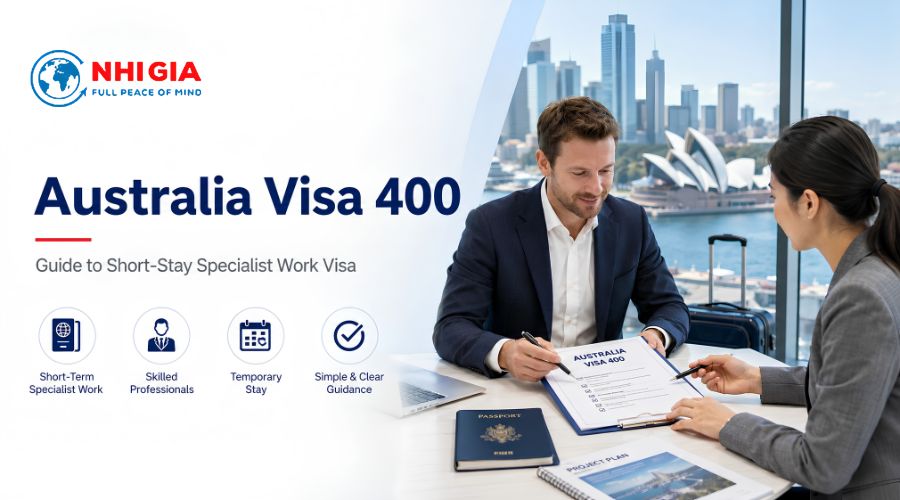
Australia Visa 400, officially known as the Temporary Work (Short Stay Specialist) visa subclass 400, is a temporary visa for foreign nationals who need to enter Australia to perform short-term, highly specialised and non-ongoing work.
This visa is usually suitable when an Australian business or organization needs an overseas specialist with specific skills, knowledge or experience to complete a short-term task, project or assignment that cannot be readily fulfilled within Australia.
Visa 400 is not a long-term work visa, not intended to fill ongoing positions and not suitable for general employment. If the work in Australia is long-term, ongoing or part of a stable employment relationship, the applicant should check other suitable visa pathways, such as skilled visas or employer-sponsored visas.
Who Is Australia Visa 400 Suitable For?
Visa 400 is usually suitable for people with specialised expertise who are invited to Australia to perform a short-term task with a clear objective and defined end date.
Common cases include:
- Technical specialists entering Australia to install, repair or transfer specialized equipment;
- Engineers, technology specialists, system operation experts or training specialists;
- Highly skilled personnel participating in a short-term project;
- Experts invited to Australia to resolve technical issues, provide specialist advice or support implementation;
- Individuals participating in short-term activities related to Australia’s interests in limited circumstances;
- Persons invited by an Australian organization to perform specific, non-ongoing work or activity.
Visa 400 should not be understood as a general solution to “work in Australia for a few months and see what happens.” This visa requires a clear purpose, clear work and clear evidence.
When Is Visa 400 Not Suitable?
Visa 400 is not suitable if the applicant’s main purpose is:
- Long-term work in Australia;
- General work or work that is not highly specialised;
- An ongoing, repetitive or long-term position;
- Long-term study in Australia;
- Entertainment, performing arts, film, television or public performance activities if another visa category is required;
- Workplace-based training, internship or long-term training program;
- Job seeking in Australia;
- Migration or long-term stay in Australia.
If the purpose is workplace training, entertainment, sports, research, long-term employment or employer-sponsored work, another suitable visa category should be checked.
How Long Is Australia Visa 400 Valid?
Australia Visa 400 is usually granted for a short stay, commonly up to 3 months. In limited cases, the stay may be up to 6 months if there is a suitable reason and the assessing authority approves it.
Therefore, it should not be stated that visa 400 is “automatically 3 to 6 months.” A more accurate wording is: visa 400 is generally for short-term, non-ongoing work; the stay is usually up to 3 months, and a longer stay must be justified and depends on the decision of the Australian Department of Home Affairs.
Benefits of Australia Visa 400 Holders
Visa 400 holders may have certain benefits within the scope of the granted visa.
Common benefits include:
- Entering and staying in Australia during the visa validity;
- Performing the approved highly specialised work or activity stated in the application;
- Participating in activities related to Australia’s interests in limited circumstances;
- Including eligible family members in the application when applying;
- Traveling during the visa validity if the visa conditions allow;
- Being protected under Australian law while lawfully staying and working in Australia.
Important note: visa 400 holders may only perform the work or activity approved under the visa. Doing other work, working for another entity or extending the work beyond the original purpose may breach visa conditions.
Can Family Members Accompany a Visa 400 Applicant?
Applicants may include members of the family unit in the visa 400 application when applying. Accompanying family members must also meet relevant health, character and dossier requirements.
However, accompanying family members are generally not allowed to work in Australia. Therefore, if a spouse or dependant also intends to work, study long-term or stay for a separate purpose, the suitable visa type for each person should be checked instead of assuming that inclusion in the visa 400 application is sufficient.
Requirements for Australia Visa 400
To apply for visa 400, the applicant must show that the purpose of travel to Australia fits the visa nature: short-term, highly specialised and non-ongoing.
Common requirements include:
- Having specialised skills, knowledge or experience relevant to the work in Australia;
- The work in Australia is short-term and non-ongoing;
- The applicant’s skills or work are not readily available in Australia;
- Having an invitation letter, contract, support letter or documents from an Australian organization/company;
- Having evidence of position, duties, work period and why the applicant’s presence in Australia is needed;
- Having sufficient funds to cover the stay in Australia;
- Meeting health and character requirements;
- Having no intention to stay beyond the visa validity;
- Not using visa 400 as a substitute for long-term work visa categories.
Not every application requires “good English” through a specific test. However, if the work involves communication, workplace safety or professional coordination, English ability or language support arrangements may need to be explained in the dossier.
Required Documents for Australia Visa 400
Specific documents may vary depending on work purpose, industry, inviting organization, nationality, visa history and the applicant’s personal circumstances. In general, a visa 400 dossier should be prepared under the following groups:
Personal Documents
- Valid passport;
- National ID or identity document;
- Birth certificate, marriage certificate if relevant;
- Photo according to system requirements;
- Personal background or residence information if required;
- Documents proving residence status in the country of residence if applying outside Vietnam.
Documents Proving Work Purpose in Australia
This is the most important document group for a visa 400 application. The applicant must show that the work in Australia is highly specialised, short-term and non-ongoing.
Documents may include:
- Invitation letter from an Australian organization/company;
- Service contract, work contract or project agreement;
- Work description, duties or project details in Australia;
- Work period;
- Reason why the applicant’s physical presence in Australia is required;
- Evidence that the applicant’s skills are not readily available in Australia;
- Work location, receiving organization and responsible contact in Australia;
- Evidence of salary, allowances, covered expenses or working conditions;
- Documents explaining that the work will not adversely affect employment, training opportunities or workplace conditions in Australia if required.
Documents Proving Expertise and Experience
The applicant must prove that they have the relevant capability for the short-term work in Australia.
Documents may include:
- CV or professional profile;
- Degrees and professional certificates;
- Employment experience confirmation;
- Appointment letter, employment contract or current position confirmation;
- Documents about previous projects;
- Technical certificates, training certificates or professional licenses if required by the industry;
- Vietnamese company documents if the applicant is a business owner or specialist assigned by a company.
Financial Documents
The applicant must show sufficient funds for the stay in Australia, unless the relevant company/organization covers the expenses and this is clearly documented.
Documents may include:
- Bank statements;
- Balance confirmation;
- Income evidence;
- Letter confirming company expense coverage;
- Contract or documents showing that travel, accommodation, insurance and living costs are covered by the inviting or sending organization;
- Business financial documents if relevant.
Documents for Accompanying Family Members if Any
If family members accompany the main applicant, additional documents may include:
- Passport of each family member;
- Birth certificate, marriage certificate or documents proving relationship;
- Health and character documents if required;
- Financial evidence for the whole family during the stay;
- Information about the stay plan in Australia;
- Other documents required by the Australian Department of Home Affairs.
Australia Visa 400 Application Process
Step 1: Check Whether Visa 400 Is Suitable. Before preparing the application, the applicant should determine whether the work in Australia is truly short-term, highly specialised and non-ongoing. If the work does not match visa 400, another visa type should be checked before lodging.
Step 2: Prepare Documents. The applicant prepares personal documents, professional documents, invitation letter, contract, job description, financial documents and documents for family members if any. Non-English documents are usually required to be translated into English.
Step 3: Lodge the Application Online Through ImmiAccount. The applicant creates or logs into ImmiAccount, completes the application, uploads documents, reviews the information and lodges the application online. The Department of Home Affairs Visa Pricing Estimator can help estimate the visa application charges at the time of lodgement.
Step 4: Pay the Visa Application Charge. After completing the online application, the applicant pays the fee as instructed by the system. Fees may change depending on lodgement date, accompanying applicants and dossier information. Therefore, the official fee should be checked at the time of application rather than relying on old figures.
Step 5: Provide Biometrics or Additional Documents if Requested. The Australian Department of Home Affairs may request biometrics, health examinations, police checks or additional documents depending on the application. The applicant should monitor email and ImmiAccount to respond on time.
Step 6: Receive the Visa Decision. The visa decision is usually notified through the account or registered email. If granted, the applicant should carefully check visa information, validity, entry conditions and attached visa conditions before making travel arrangements.
How Much Is the Australia Visa 400 Fee?
The original article states that the visa 400 fee is AUD 405, but Australian visa fees may change from time to time. For a 2026 update, an old fee should not be reused without checking the lodgement date.
On the Department of Home Affairs visa charge calculation page, Temporary Work (Short Stay Specialist) visa subclass 400 currently shows a Base Application Charge of AUD 325 in the table for applicants outside Australia. However, applicants should still use the Visa Pricing Estimator to check the official cost at the time of application, as fees may depend on lodgement date, location, lodgement method and accompanying applicants.
In addition to the visa application charge, applicants may incur:
- Biometrics fee;
- Health examination fee;
- Police certificate fee if required;
- Translation, notarization/certification fees;
- Scanning and document preparation fees;
- Service fee if using a consultant or dossier support provider;
- Insurance, airfare, accommodation and living costs in Australia.
How Long Does Australia Visa 400 Take to Process?
Australian visa 400 processing time is not fixed for every application. It depends on application volume, document quality, clarity of the work purpose, biometrics/health requirements, additional requests and the Department of Home Affairs’ assessment progress.
Applicants should check the Department of Home Affairs Global visa processing times tool at the time of application for an indicative timeframe. It should not be stated that “visa 400 is approved within X days” for every case.
Common Mistakes When Applying for Australia Visa 400
Common mistakes include:
- Using visa 400 for long-term or ongoing work;
- Failing to prove that the work is highly specialised;
- Providing an overly general invitation letter from Australia;
- Not explaining why an overseas specialist is required in Australia;
- Describing the work like an ongoing employment position;
- Failing to prove relevant skills, experience or qualifications;
- Not providing sufficient financial evidence;
- Inconsistency between invitation letter, contract, CV and stay period;
- Requesting 6 months without a strong reason;
- Confusing visa 400 with a visitor visa, business visitor visa or long-term work visa;
- Purchasing non-refundable flights before receiving the visa result.
These mistakes may lead to additional requests, longer processing time or refusal.
How is visa 400 different from an Australian visitor/business visitor visa?
| Criteria | Australia Visa 400 | Australian Visitor/Business Visitor Visa |
| Main purpose | Short-term, highly specialised, non-ongoing work | Tourism, family visit or short business visit without performing specialist work in Australia |
| Nature of activity | May perform the work approved in the application | Not used for working in Australia |
| Key evidence | Invitation letter, work description, specialist skills, reason for overseas specialist | Itinerary, finances, ties, travel/family/business visit purpose |
| Stay period | Usually up to 3 months; longer period only in limited cases | Depends on the visa granted |
| Suitable for | Specialists, technical personnel, short-term specialised projects | Tourists, family visitors, meetings, conferences, non-work business visits |
Australia Visa 400 Support Service by Nhị Gia
Visa 400 requires clear evidence that the work is short-term, highly specialised, non-ongoing and reasonably requires the foreign national’s presence in Australia. If the dossier only states generally that the applicant is “going to work,” it is unlikely to be persuasive.
With experience in visa and international dossier support, Nhị Gia assists clients in preparing Australia visa 400 applications based on each specific case.
Nhị Gia supports clients with:
- Advising whether visa 400 is suitable for the intended purpose in Australia;
- Distinguishing visa 400 from visitor, business visitor, training or long-term work visas;
- Reviewing invitation letters, contracts, work descriptions and reasons for needing an overseas specialist;
- Guiding preparation of personal, professional, experience and financial documents;
- Supporting standardization of documents from the Australian organization and Vietnamese company if any;
- Supporting translation, notarization/certification if required;
- Guiding online lodgement through ImmiAccount;
- Tracking application progress and supporting additional requests if any;
- Maintaining confidentiality of personal information, company documents and project materials.
Nhị Gia does not guarantee visa outcomes for every application, as the final decision belongs to the Australian Department of Home Affairs. However, identifying the correct visa type, preparing a clear dossier and proving the nature of the work from the beginning can help reduce errors and strengthen the application.
Nhị Gia Service Timeline
The visa 400 processing time shown by the Department of Home Affairs tool or guidance refers to the assessment period after the application is lodged and ready for consideration. It is not the entire actual timeline when clients use Nhị Gia’s dossier support service.
When using Nhị Gia’s service, the actual timeline depends on dossier status, how quickly the client provides documents, clarity of the invitation letter and work description, documents from the Australian organization, translation/notarization needs, biometrics requirements, additional requests if any and the Department of Home Affairs’ processing progress.
Nhị Gia will advise the estimated timeline after reviewing the client’s specific dossier. The service timeline should not be understood as always equal to the Department of Home Affairs’ assessment time, because the actual process also includes consultation, review, standardization and dossier completion before lodgement.
Contact Nhị Gia for Australia Visa 400 Consultation
If you need to enter Australia for short-term, highly specialised work or need to send a specialist to Australia to support a project, you should check visa 400 requirements before preparing the application.
Please contact Hotline 1900 6654 or email info@nhigia.vn for case-specific consultation from Nhị Gia’s specialists.