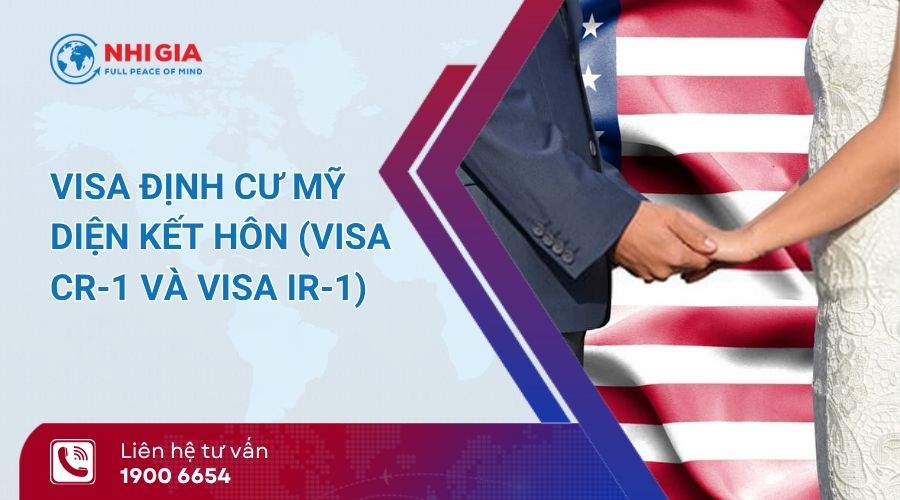
A U.S. spouse immigrant visa is designed for the foreign spouse of a U.S. citizen or lawful permanent resident who wishes to immigrate to the United States. Within this category, CR-1 and IR-1 visas are commonly associated with legally married spouses.
Depending on the length of the marriage, the petitioner’s status, financial sponsorship, relationship evidence and case processing, the applicant may be admitted as a conditional permanent resident or as a permanent resident without conditions after entering the United States with an immigrant visa.
This article provides an overview of CR-1 and IR-1 visas, eligibility requirements, required documents, application process and key notes for U.S. spouse immigration cases.
What are CR-1 and IR-1 visas?
CR-1 and IR-1 are U.S. immigrant visas for the spouse of a U.S. citizen. They allow the foreign spouse to enter the United States for the purpose of becoming a lawful permanent resident, provided that the application is approved and all requirements are met.
In practice, CR-1 and IR-1 are generally distinguished based on the length of the marriage at the time the foreign spouse obtains permanent resident status.
What is a CR-1 visa?
CR-1 stands for Conditional Resident. This classification generally applies where the marriage is less than 2 years old at the time the foreign spouse obtains permanent resident status.
A conditional permanent resident usually receives a 2-year Green Card. Before the conditional Green Card expires, the couple must file to remove the conditions on residence in accordance with the applicable requirements in order to be considered for a 10-year Green Card.
What is an IR-1 visa?
IR-1 stands for Immediate Relative. This classification generally applies where the marriage is at least 2 years old at the time the foreign spouse obtains permanent resident status.
A spouse admitted to the United States under the IR-1 category is generally processed as a permanent resident without conditions and may receive a 10-year Green Card.
Is there a difference between sponsorship by a U.S. citizen and a lawful permanent resident?
Both U.S. citizens and lawful permanent residents may file Form I-130 to petition for a foreign spouse. However, the case category, processing timeline, visa availability and classification may differ depending on the petitioner’s status.
A spouse of a U.S. citizen is generally treated as an immediate relative. A spouse of a lawful permanent resident may fall under the relevant family preference category and may be affected by visa availability at the time of processing.
Before starting the case, it is important to confirm whether the petitioner is a U.S. citizen or lawful permanent resident, the marital status, residence situation, financial capacity and sponsorship plan.
Eligibility requirements for CR-1/IR-1 spouse immigration
To start a spouse immigration case, the petitioner and beneficiary generally need to meet the following conditions:
- The petitioner is an eligible U.S. citizen or lawful permanent resident;
- The marriage is legally valid;
- The marriage was not entered into solely for immigration purposes;
- The couple can provide evidence that the marital relationship is genuine and continuing;
- Any prior marriages of either spouse have legally ended;
- The petitioner meets the financial sponsorship requirements or has a joint sponsor where needed;
- The beneficiary is not inadmissible or otherwise ineligible under U.S. immigration law;
- Information provided in the application is truthful, consistent and supported by documents.
In international marriage cases, the reviewing authorities often focus on the genuineness of the marriage, previous marital history, how the couple met, evidence of contact and shared life, financial sponsorship and plans after reunification in the United States.
Required documents for a U.S. spouse immigrant visa
A U.S. spouse immigration case is generally processed through several stages: filing the petition with USCIS, processing with the National Visa Center and attending the immigrant visa interview at the consular post. Required documents may vary by stage.
Documents for the USCIS petition stage
The petitioner generally begins by filing Form I-130, Petition for Alien Relative, to establish the qualifying spousal relationship. For spouse petitions, Form I-130A for the beneficiary spouse is also commonly required.
Documents at the USCIS stage may include:
- Form I-130;
- Form I-130A, if applicable;
- Evidence of the petitioner’s U.S. citizenship or lawful permanent resident status;
- Marriage certificate;
- Evidence that any prior marriages have legally ended, if applicable;
- Evidence that the marital relationship is genuine;
- Photos, identity documents and other supporting materials;
- Filing fee according to the USCIS fee schedule at the time of filing.
Documents for the NVC stage
After USCIS approves the I-130 petition, the case is usually forwarded to the National Visa Center for further processing.
At the NVC stage, the petitioner and beneficiary generally need to complete:
- Payment of required NVC processing fees;
- Form DS-260, Immigrant Visa Electronic Application;
- Form I-864, Affidavit of Support;
- Financial documents of the petitioner;
- Civil documents of the beneficiary;
- Passport;
- Birth certificate;
- Marriage certificate;
- Divorce decree or death certificate of any former spouse, if applicable;
- Police certificates as required;
- Evidence of the marital relationship;
- Other documents requested by NVC.
Form I-864 is the Affidavit of Support, through which the sponsor accepts financial responsibility for the intending immigrant under U.S. law. If the petitioner’s income is insufficient, a qualified joint sponsor may be required.
Documents for the interview stage
Once the case becomes documentarily qualified and an interview is scheduled, the beneficiary should prepare documents according to the consular post’s instructions.
Pre-interview documents may include:
- Interview appointment letter;
- Valid passport;
- DS-260 confirmation page;
- U.S. immigrant visa photos;
- Original and copy of civil documents;
- Medical examination and vaccination records from an authorized panel physician;
- Police certificates;
- Updated relationship evidence;
- Financial documents, if requested;
- Fee receipts or payment confirmations;
- Additional documents listed in the consular checklist.
For cases interviewed at the U.S. Consulate General in Ho Chi Minh City, applicants should follow the post-specific instructions on online registration, medical examination, pre-interview checklist and required original documents.
Relationship evidence for CR-1/IR-1 cases
Relationship evidence is one of the most important parts of a U.S. spouse immigrant visa case. The application should show that the marriage is genuine, based on a real relationship and supported by shared plans after reunification.
Evidence may include:
- Photos together across different stages of the relationship;
- Messages, emails, call logs or video call records;
- Flight tickets, travel itineraries, hotel bookings or evidence of in-person meetings;
- Marriage certificate, wedding photos, ceremony or family event records;
- Evidence of meeting each other’s family and friends;
- Financial transfers, financial support or shared expenses;
- Joint accounts, insurance, lease agreements or shared property, if available;
- Letters, gifts or evidence of mutual care and support;
- Plans for residence, employment, finances and family life in the United States.
Evidence should be organized chronologically to show the natural development of the relationship. Submitting many photos without context, communication records or practical evidence of commitment may not be sufficient.
Application process for CR-1/IR-1 spouse immigrant visas
The spouse immigration process generally includes the following steps.
Step 1: Check eligibility
Before filing, the petitioner and beneficiary should review marital status, petitioner status, financial capacity, marital history, visa history and any factors that may affect the case.
If the couple has prior divorces, children from previous relationships, a significant age difference, an online relationship, limited in-person meetings or previous U.S. visa refusals, the application should be prepared more carefully.
Step 2: The petitioner files Form I-130 with USCIS
The petitioner files Form I-130 and supporting documents with USCIS to establish the qualifying spousal relationship. USCIS reviews whether the petition meets the requirements.
If additional evidence is needed, USCIS may issue a request. If the petition is approved, the case is usually forwarded to NVC for immigrant visa processing.
Step 3: Complete NVC processing
After receiving the case from USCIS, NVC provides instructions for fee payment, DS-260 submission, Form I-864 submission and uploading civil and financial documents.
Once NVC determines the case is documentarily complete, the case waits for an interview appointment at the appropriate consular post.
Step 4: Complete medical examination and prepare for interview
After the interview appointment is scheduled, the beneficiary must complete the medical examination with an authorized panel physician and prepare original documents, copies, translations and updated relationship evidence.
The applicant should carefully review the consular checklist because missing key documents may delay the interview or result in a request for additional evidence.
Step 5: Attend the immigrant visa interview
At the interview, the consular officer reviews the application and may ask about the relationship, how the couple met, the marriage, reunification plans, financial sponsorship and other relevant issues.
The beneficiary should answer truthfully, clearly and consistently with the submitted application. In some cases, the case may require additional documents or administrative processing after the interview.
Step 6: Receive the visa and prepare for U.S. entry
If the visa is approved, the beneficiary will receive instructions on passport return and next steps before traveling to the United States.
Immigrant visa holders generally need to pay the USCIS Immigrant Fee as instructed, unless exempt. After entering the United States with an immigrant visa, the beneficiary will be processed for lawful permanent resident status according to the applicable category.
How long does CR-1/IR-1 processing take?
CR-1/IR-1 processing time is not fixed and depends on multiple stages, including:
- USCIS processing of Form I-130;
- Case transfer to NVC;
- Time required to complete fees, DS-260, I-864 and civil documents;
- NVC document review;
- Interview scheduling at the consular post;
- Whether the case requires additional documents or administrative processing.
For this reason, applicants should not rely on a fixed timeline for every case. It is advisable to monitor each stage and prepare complete documents from the beginning to reduce the risk of delays.
Fees for a U.S. spouse immigrant visa case
A U.S. spouse immigrant visa case may involve several fees at different stages, including USCIS, NVC, medical examination and post-approval steps.
Common fees may include:
- Form I-130 filing fee paid to USCIS;
- Immigrant visa processing fee at NVC;
- Affidavit of Support fee, where required;
- Medical examination and vaccination fees;
- Police certificate fees;
- Translation, notarization or document preparation costs;
- USCIS Immigrant Fee after visa issuance, unless exempt.
Fees may change according to the current fee schedule of each authority. The petitioner and beneficiary should check the official fee information at the time of filing instead of relying on outdated fee figures.
CR-1/IR-1 vs. K-1 visa: key differences
CR-1/IR-1 and K-1 visas both relate to marriage or intended marriage, but they are different in nature.
The K-1 visa is a nonimmigrant visa for the fiancé(e) of a U.S. citizen. It allows the fiancé(e) to travel to the United States and marry the U.S. citizen petitioner within 90 days of entry. After the marriage, the applicant may apply for adjustment of status in the United States if eligible.
By contrast, CR-1/IR-1 visas are immigrant visas for spouses who are already legally married. After entering the United States with an immigrant visa, the beneficiary is processed toward lawful permanent resident status.
The choice between K-1 and CR-1/IR-1 depends on the couple’s relationship status, marriage plan, residence situation, processing considerations, costs and case strategy.
Common issues in CR-1/IR-1 applications
A spouse immigrant visa case may face difficulties if:
- The marriage is not sufficiently documented as genuine;
- Relationship evidence is disconnected or lacks continuity;
- Information in Form I-130, DS-260, I-864 and civil documents is inconsistent;
- Divorce decrees or death certificates from previous marriages are missing;
- Financial sponsorship documents are insufficient or incomplete;
- Updated relationship evidence is not prepared before the interview;
- Interview answers are inconsistent with the application;
- Required original documents are missing at the interview;
- Prior marriages, children, visa history or residence information are not disclosed;
- Emails, NVC account messages or document requests are not monitored.
Reviewing the application before filing and before interview helps reduce the risk of requests for additional evidence, extended processing time or concerns about the sufficiency of the case.
Nhi Gia’s consulting service for U.S. spouse immigrant visas
CR-1/IR-1 spouse immigrant visa cases require careful preparation from the I-130 stage through NVC processing and the consular interview. Each case has its own circumstances, especially where there are prior divorces, children from previous relationships, age differences, online relationships, limited in-person meetings, insufficient sponsor income or prior visa refusals.
With experience in U.S. visa and family immigration documentation, Nhi Gia assists clients in reviewing eligibility, preparing documents and monitoring the case based on each specific situation.
Nhi Gia supports clients with:
- Advising on eligibility for U.S. spouse immigration;
- Identifying the appropriate case category based on petitioner status and marriage duration;
- Reviewing marriage, divorce, identity and civil documents;
- Guiding preparation of relationship evidence;
- Supporting I-130 document preparation based on client-provided information;
- Guiding DS-260, I-864 and NVC document preparation;
- Advising on pre-interview document preparation;
- Guiding clear and truthful presentation of the relationship for interview preparation;
- Advising on next steps where additional documents are requested or where the case contains complex factors.
For consultation on U.S. spouse immigrant visas CR-1/IR-1 or other family-based immigration cases, please contact Nhi Gia for detailed support.