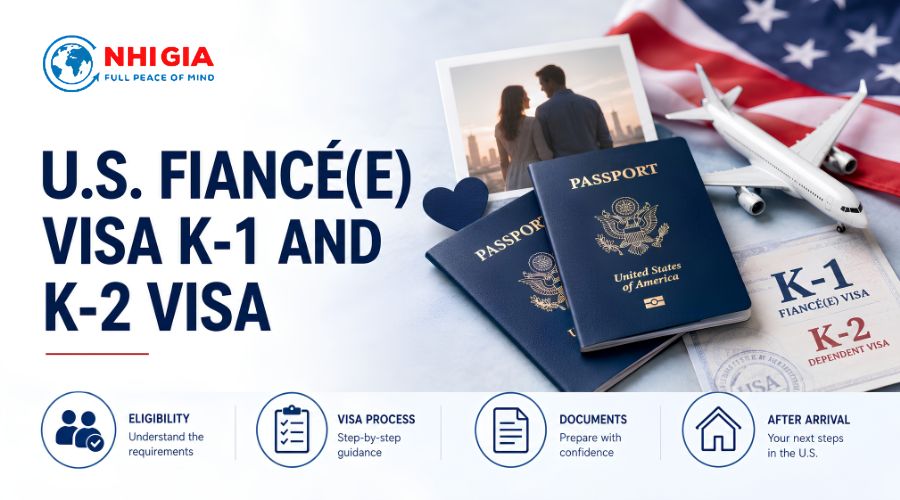
The U.S. K-1 fiancé(e) visa is designed for the foreign-citizen fiancé(e) of a U.S. citizen. It allows the foreign-citizen fiancé(e) to travel to the United States and marry the U.S. citizen petitioner within 90 days of admission.
After the marriage takes place in the United States, the K-1 visa holder may apply for adjustment of status to become a lawful permanent resident, provided that all applicable requirements are met.
If the K-1 applicant has eligible children who will accompany or follow to join the principal applicant, the children may apply for K-2 visas. K-2 visas are dependent visas for eligible children of the K-1 visa applicant.
What is a U.S. K-1 fiancé(e) visa?
A K-1 visa is a nonimmigrant visa for the foreign-citizen fiancé(e) of a U.S. citizen. The purpose of the K-1 visa is to allow the applicant to enter the United States and marry the same U.S. citizen who filed the petition.
After entering the United States on a K-1 visa, the applicant must marry the U.S. citizen petitioner within 90 days. If the marriage does not take place within this period, the K-1 status expires and the applicant may face immigration-related risks in the United States.
It is important to note that the K-1 visa is only available where the petitioner is a U.S. citizen. A U.S. lawful permanent resident cannot petition for a fiancé(e) under the K-1 visa category.
What is a K-2 visa?
A K-2 visa is issued to an eligible child of a K-1 visa applicant. The child may accompany or follow to join the principal K-1 applicant in the United States.
Each K visa applicant, including both K-1 and K-2 applicants, must complete a separate visa application, including a separate DS-160, separate visa fee and required civil, medical and supporting documents.
To be considered for a K-2 visa, the child’s information should be listed in the Form I-129F petition filed by the U.S. citizen petitioner. If the child’s information was not properly included or if there are changes in the dependent child’s circumstances, the case should be reviewed carefully before proceeding.
Basic requirements for a K-1 fiancé(e) visa
To start a K-1 fiancé(e) visa case, the petitioner and applicant generally need to meet the following requirements:
- The petitioner must be a U.S. citizen;
- Both parties intend to marry within 90 days after the applicant enters the United States on a K-1 visa;
- Both parties are legally free to marry;
- The couple has met in person at least once within the two years before filing the petition, unless an exception applies;
- The relationship is genuine and supported by evidence of communication, meetings and intention to marry;
- The U.S. citizen petitioner files Form I-129F with USCIS.
In addition, the case may be reviewed based on financial support, prior marriages, immigration history, criminal history, consistency of information and the applicant’s ability to demonstrate a genuine relationship during the visa interview.
K-1 visa application process
The K-1 visa process involves several stages, from filing the petition with USCIS to attending the visa interview at a U.S. consular post.
Step 1: The U.S. citizen petitioner files Form I-129F with USCIS
The U.S. citizen petitioner files Form I-129F to petition for the foreign-citizen fiancé(e). The petition should include information about both parties, their marital status, evidence of having met in person and evidence of the relationship.
Step 2: USCIS reviews the petition
USCIS reviews the I-129F petition. During the review, USCIS may issue a request for additional evidence if the submitted documents are not sufficient to make a decision.
If the petition is approved, USCIS will forward the case to the National Visa Center for further consular processing.
Step 3: NVC forwards the case to the U.S. Embassy or Consulate
After receiving the approved petition from USCIS, the National Visa Center forwards the case to the U.S. Embassy or Consulate that will process the K-1 visa application.
For applicants in Vietnam, the case will be handled according to the instructions issued by the relevant U.S. consular post. The applicant should carefully follow the instruction letter and prepare the required documents before scheduling the interview, completing the medical examination and attending the visa interview.
Step 4: The applicant completes Form DS-160, medical examination and document preparation
The applicant must complete Form DS-160 online, print the confirmation page, pay the visa fee, prepare civil documents, financial support evidence, relationship evidence and complete the medical examination with an authorized panel physician.
All information should be checked carefully to ensure consistency across the documents, especially names, dates of birth, marital history, divorce records, dependent children and the relationship timeline.
Step 5: K-1/K-2 visa interview
The applicant attends the visa interview as scheduled. The consular officer reviews the documents, evaluates the relationship, the purpose of travel, financial support and other factors relevant to visa eligibility.
If additional information is needed, the officer may request further documents or place the case under administrative processing. This is why document preparation and consistency should be handled carefully from the beginning.
Step 6: Entry into the United States and marriage within 90 days
After the K-1 visa is issued, the applicant enters the United States and marries the U.S. citizen petitioner within 90 days of admission.
After the marriage, the applicant may apply for adjustment of status to obtain a Green Card if all requirements are met.
Documents required for a K-1 fiancé(e) visa
The document checklist may vary depending on each case. In general, a K-1 visa applicant should prepare the following:
- DS-160 confirmation page;
- Valid passport;
- U.S. visa photos meeting the applicable requirements;
- Birth certificate;
- Divorce decree or death certificate of any previous spouse, if either party was previously married;
- Police certificates as required;
- Medical examination records;
- Financial support documents or evidence of support from the U.S. citizen petitioner;
- Evidence of the relationship;
- Visa fee payment receipt;
- Instruction letter, appointment letter or other documents from NVC or the U.S. consular post, if applicable.
Relationship evidence may include photos together, communication history, flight tickets, travel itineraries, receipts, letters, gift records, engagement-related evidence, family-related information and other materials showing a genuine, ongoing relationship and clear intention to marry.
The consular officer may request additional documents depending on the case. Therefore, the checklist should be reviewed according to the latest instructions at the time of application and the specific circumstances of the applicant.
Documents required for a K-2 visa
For an eligible child of a K-1 applicant, a separate K-2 visa application is generally required for each child.
The documents may include:
- Separate DS-160 confirmation page;
- Valid passport;
- U.S. visa photos meeting the applicable requirements;
- Birth certificate;
- Medical examination records;
- Police certificates if required by age or case circumstances;
- Documents proving the parent-child relationship with the K-1 applicant;
- Custody documents, consent for the child to travel or family status documents, if applicable;
- Visa fee payment receipt;
- Other documents requested by the U.S. consular post.
Where dependent children are involved, the applicant should carefully review the child’s age, marital status, whether the child will accompany or follow to join, and whether the child was properly listed in the I-129F petition.
How long does K-1/K-2 visa processing take?
The processing time for a K-1 fiancé(e) visa is not fixed. The overall timeline depends on multiple factors, including USCIS processing, transfer to NVC, interview availability at the U.S. consular post, the condition of the case, requests for additional documents and possible administrative processing after the interview.
The actual timeline may vary from case to case. Applicants should avoid relying on a general estimated timeframe when making important plans such as wedding arrangements, resignation, travel bookings or relocation schedules.
Nhi Gia recommends preparing the case early, checking the consistency of all documents and following the latest instructions issued by the competent authorities at each stage of the process.
K-1/K-2 visa fees and related costs
The cost of a K-1/K-2 visa case may include several items at different stages of the process, such as:
- USCIS filing fee for Form I-129F;
- K visa application fee under the U.S. Department of State fee schedule;
- Medical examination fee;
- Translation, notarization and document copying fees;
- Police certificate or civil document fees;
- Travel, accommodation, document preparation and other incidental costs.
According to the U.S. Department of State visa fee schedule, the K visa application fee is USD 265 per applicant. However, fees may change according to the applicable schedule at the time of application. Applicants should check the current official fee before making payment.
Why can a K-1/K-2 visa case be refused or delayed?
A K-1/K-2 visa case may be refused, delayed or placed under additional review for various reasons, including:
- Insufficient relationship evidence;
- Inconsistent information between the petitioner and applicant;
- Unclear prior marriage, divorce or dependent child information;
- Missing civil documents, police certificates, financial documents or supporting evidence;
- Issues relating to personal background, immigration history, financial support or legal eligibility;
- Unclear, inconsistent or inadequate interview answers.
In some cases, the consular officer may request additional documents before continuing the review. This does not always mean a final refusal, but it may extend the processing timeline.
Frequently asked questions about K-1 and K-2 visas
What should the applicant do after receiving a K-1 visa?
The applicant must enter the United States and marry the U.S. citizen petitioner within 90 days of admission. After the marriage, the applicant may apply for adjustment of status to obtain a Green Card if eligible.
Can K-1 status be extended after entry?
K-1 status is valid for 90 days after admission and cannot be extended. If the applicant does not marry the U.S. citizen petitioner within this period, the applicant may not be eligible to adjust status based on the K-1 classification.
How long is the approved I-129F petition valid?
An approved I-129F petition is generally valid for four months from the date of USCIS approval. If more time is needed for consular processing, a consular officer may revalidate the petition in accordance with applicable rules.
Can the applicant travel to the United States on a visitor visa while the K-1 case is pending?
It may be possible if the applicant has an appropriate visa and meets the conditions for entry. However, applying for or using a visitor visa while a K-1 case is pending may result in closer review of the applicant’s purpose of travel. Applicants should seek case-specific advice before planning travel to the United States during the K-1 process.
Is the K-1 visa an immigrant visa?
The K-1 visa is a nonimmigrant visa. However, it is closely connected to marriage and potential adjustment of status after marriage. For this reason, the case should be prepared with a high level of consistency regarding the purpose of travel, intention to marry and post-marriage residence plans.
Nhi Gia’s K-1/K-2 visa consulting service
A U.S. fiancé(e) visa case requires careful preparation of legal documents, relationship evidence, personal background information and interview readiness. Each case has its own circumstances, especially where there has been a prior marriage, dependent children, age difference, online relationship, short in-person meeting history or previous U.S. visa refusal.
With practical experience in U.S. visa case support, Nhi Gia provides case-specific consultation, including:
- Reviewing eligibility for K-1/K-2 visa cases;
- Checking petitioner and applicant information;
- Advising on relationship evidence preparation;
- Providing document guidance at each stage;
- Reviewing consistency across the case;
- Supporting interview preparation;
- Advising on next steps where additional documents or further processing are required.
The statutory processing time and the actual service timeline may differ depending on the condition of the case, processing schedules of the relevant authorities, requests for additional documents and other factors arising during the process. Nhi Gia will advise the estimated timeline after reviewing the client’s specific case.
For consultation on U.S. K-1 fiancé(e) visas, K-2 visas or other U.S. visa categories, please contact Nhi Gia for detailed support.