What Should Couples Know Before Applying for an Australian Partner Visa?
Australian partner visa sponsorship is one of the most common pathways for couples who plan to reunite and live together in Australia. However, this is also a dossier that requires careful preparation because the reviewing authority does not only look at a marriage certificate, but also assesses the relationship history, evidence of commitment, future plans and consistency of the entire application.
Before applying for an Australian partner visa, couples should identify the correct visa pathway, prepare relationship evidence and understand the online application process through the Australian Department of Home Affairs system.
Should You Apply as a Married Partner or Prospective Marriage Applicant?
Choosing between a married partner visa and a prospective marriage visa depends on the couple’s actual relationship status at the time of application. This is an important step because selecting the wrong visa pathway may make the application ineligible or inconsistent with the actual purpose.
In general, couples should distinguish between three common pathways:
- Partner visa for spouse or de facto partner applying from outside Australia: usually subclass 309/100;
- Partner visa for spouse or de facto partner applying from inside Australia: usually subclass 820/801;
Prospective Marriage visa: subclass 300, for applicants who intend to travel to Australia to marry their sponsor.
Similarities Between Partner Visa and Prospective Marriage Visa
These visa pathways all aim to allow an Australian citizen, Australian permanent resident or eligible New Zealand citizen to sponsor their partner to Australia if the requirements are met.
Similarities include:
- The relationship must be genuine;
- Evidence of how the couple met, spent time together and maintained the relationship is required;
- The couple must show an intention to build a life together;
- The sponsor and applicant must meet character, health and background requirements where applicable;
- The application must be truthful, complete and consistent;
- Dependent children may be included if they meet the relevant visa requirements.
However, each visa pathway has its own conditions. Couples should not apply randomly just because the general goal is to live together in Australia.
Differences Between Partner Visa and Prospective Marriage Visa
| Criteria | Spouse or De Facto Partner Pathway | Prospective Marriage Pathway |
| Relationship status | Legally married or in an eligible de facto relationship | Engaged and intending to marry in Australia |
| Common visa subclasses | 309/100 if applying offshore; 820/801 if applying onshore | Prospective Marriage visa subclass 300 |
| Purpose | To reunite and live with a spouse or partner in Australia | To travel to Australia to marry the sponsor |
| Initial stay | Depends on the visa subclass and grant decision | Usually 9-15 months from the visa grant date |
| Next step | Assessed through temporary and permanent partner visa stages if eligible | After marriage, apply for Partner visa 820/801 before visa 300 expires |
| Evidence focus | Genuine, continuing marriage/de facto relationship with long-term commitment | Genuine relationship, in-person meeting and genuine intention to marry |
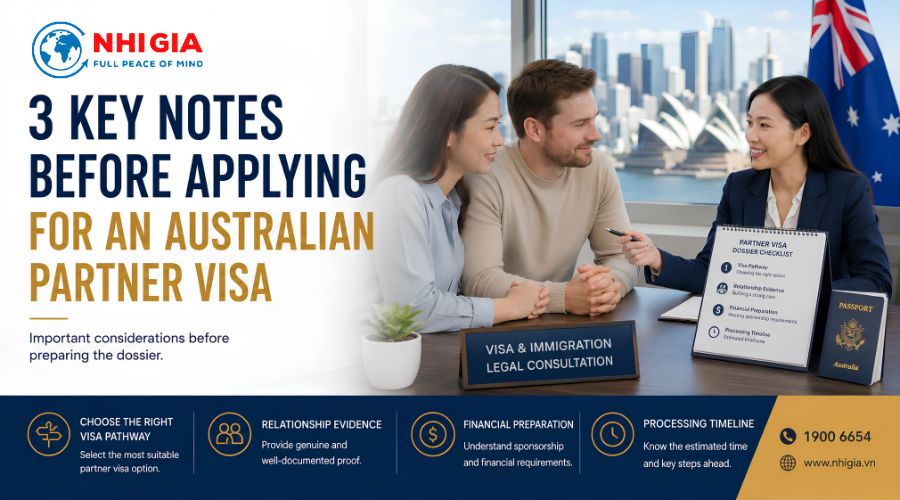
3 Important Notes Before Applying for an Australian Partner Visa
1. Choose the Correct Visa Pathway Before Preparing the Dossier
Before opening the application, the couple must clearly identify their relationship status: legally married, in a de facto relationship or engaged with the intention to marry in Australia.
If the couple is legally married or in an eligible de facto relationship, the application may be assessed under a Partner visa pathway. If the couple is not yet married but intends to travel to Australia to marry, the Prospective Marriage visa subclass 300 may be the pathway to review.
Choosing the correct visa type directly affects the required documents, evidence, application timing and the next steps after the visa is granted.
2. Prepare Relationship Evidence Systematically
One of the most important parts of an Australian partner visa application is relationship evidence. A marriage certificate or engagement evidence is only part of the dossier, not the entire application.
Evidence should be organized by category and timeline, including:
- Evidence of relationship history and development. This may include when the couple met, how the relationship developed, in-person meetings, trips together, photos across different stages, flight tickets, hotel bookings or documents showing that the relationship has been genuinely maintained.
- Communication evidence. This may include messages, emails, call history, letters or evidence of communication during periods of separation. Applicants do not need to submit thousands of pages of messages, but the selected evidence should sufficiently show that the relationship has been maintained continuously and naturally.
- Financial or shared responsibility evidence. This may include joint accounts, money transfers, shared living expenses, financial support, joint assets or financial responsibilities shared by both parties where available.
- Shared life evidence. This may include lease agreements, correspondence sent to the same address, utility bills, daily life photos, evidence of caring for children together or documents showing that the couple has shared a life.
- Social evidence. This may include photos with family and friends, statements from relatives, evidence of attending events together or proof that the relationship is known and recognized by family and friends.
- Long-term commitment evidence. This may include plans to live in Australia, financial plans, housing plans, marriage plans, family plans or documents showing the couple’s intention to build a life together.
3. Check Consistency Before Submission
Australian partner visa applications usually include many documents: visa forms, sponsor information, identity documents, marriage certificate, relationship evidence, travel history, family information, police checks, health examinations and explanation letters if any.
Key information that must remain consistent includes:
- Date the couple first met;
- Date the relationship officially began;
- Periods of in-person meetings;
- Periods of living together or living apart;
- Residential addresses of both parties;
- Previous marital status if any;
- Details of children, stepchildren or dependants;
- Visa and travel history;
- Statements from the sponsor and applicant.
If the application has special circumstances such as previous divorce, previous visa refusal, long-distance relationship, family not knowing about the relationship, significant age gap, language difference or cultural difference, the couple should prepare clear explanations from the beginning.
Where to Lodge an Australian Partner Visa Application
Australian partner visa applications are generally lodged online through the Department of Home Affairs’ ImmiAccount system. The applicant must create an account, complete the application, upload documents, pay the application fee and track the status through the system.
Depending on the visa subclass, the application may be lodged while the applicant is outside Australia or inside Australia. Submitting under the wrong pathway or from the wrong location may affect the application, so this must be checked carefully before starting.
After submission, the applicant may be asked to provide biometrics, health examinations, police checks or additional relationship evidence. Not every application requires an interview. If the assessing authority needs further clarification, the applicant or sponsor may be asked to provide explanations or attend an interview.
Can Dependent or Stepchildren Be Included in an Australian Partner Visa Application?
Dependent children may be included in an Australian partner visa application if they meet the requirements of the relevant visa subclass. Depending on the case, the child may be a biological child, adopted child or stepchild of the applicant.
In general, the dossier should prove:
- The legal relationship between the child and parent;
- The child remains dependent as required;
- The child’s marital status if old enough;
- Custody rights or consent from the other parent if the child is under 18;
- The child meets health and character requirements;
- The child’s information is declared fully and consistently with the main application.
If the child is not included in the initial application or circumstances change after lodgement, the suitable handling direction should be checked. Some cases may involve a dependent child visa or separate supplementary procedure.
What Evidence Should Couples With Children Prepare?
If the couple has children together, this can be an important category of evidence showing the family relationship. However, having children together does not mean the application will automatically be approved. The couple must still prove that the relationship is genuine, continuing and committed.
Evidence may include:
- Child’s birth certificate;
- Family photos across different stages;
- Evidence that both parents care for and raise the child together;
- School, medical or daily life documents showing parental information;
- Financial evidence related to child support;
- Statements explaining the shared life, childcare arrangements and family plans in Australia.
Vietnamese documents usually need to be translated into English according to application requirements. Translations must be accurate, complete and consistent with information declared in the visa application.
Do Couples Need to Prepare for an Interview?
Not every partner visa application requires an interview. However, couples should understand the contents of the submitted application and be prepared in case the assessing authority requests further clarification.
Instead of memorizing answers, couples should understand their real relationship story and ensure that their answers are consistent with the dossier. Mechanical answers or an overly perfect story may make the application feel less natural.
Key points to know include:
- When, where and how the couple met;
- How the relationship developed;
- In-person meetings;
- Marriage date or intended marriage plan;
- Information about both families;
- Plans to live in Australia;
- Reasons for living apart if applicable;
- Evidence submitted in the application.
Truthful, clear and consistent answers are more important than trying to impress with an overly rehearsed story.
How Long Does an Australian Partner Visa Take to Process?
The processing time for an Australian partner visa depends on the visa subclass, dossier completeness, application volume, health examinations, police checks, information verification and how quickly the applicant responds to requests for further information.
It should not be stated that spouse applications are always faster or prospective marriage applications are always slower in every case. In practice, each application has its own level of complexity. A complete, clear and consistent dossier usually has a better processing basis than an application with missing evidence or repeated verification issues.
When using Nhị Gia’s service, the actual timeline does not only include the Department of Home Affairs’ assessment time. The service process also includes consultation, eligibility review, evidence checking, translation/notarization guidance, application preparation, submission, progress tracking and support for additional requests if any.
Nhị Gia will advise the estimated timeline after reviewing the client’s specific dossier.
Australian Partner Visa Consultation Service by Nhị Gia
Australian partner visa applications require careful preparation because they involve multiple factors: marital status, relationship evidence, sponsor documents, applicant documents, dependent children, visa history, health, police checks and plans to live in Australia.
With more than 20 years of experience in visa and international dossier support, Nhị Gia assists clients in checking eligibility, identifying the suitable visa pathway and preparing the application based on each specific case.
Nhị Gia supports clients with:
- Advising on the suitable pathway: spouse, de facto partner or prospective marriage;
- Checking the eligibility of the sponsor and applicant;
- Guiding relationship evidence preparation;
- Reviewing personal documents, marriage documents and dependent child documents if any;
- Supporting translation, notarization/certification where required;
- Guiding online application preparation through ImmiAccount;
- Monitoring application progress after submission;
- Supporting additional requests if any;
- Maintaining confidentiality of clients’ personal information and dossier status.
Nhị Gia does not guarantee visa outcomes for every application, as the final decision belongs to the Australian Department of Home Affairs. However, preparing the correct visa pathway, sufficient evidence and a consistent dossier from the beginning can help reduce errors and strengthen the application.
If you are unsure whether to apply under a spouse, de facto partner or prospective marriage pathway, you should review eligibility and relationship evidence before lodging the application.
Please contact Hotline 1900 6654 or email info@nhigia.vn for case-specific consultation from Nhị Gia’s specialists.