Can You Reapply After an Australian Visa Refusal?
Australian visa refusal does not mean that clients can never be granted an Australian visa in the future. In many cases, applicants may reapply if they understand the refusal reasons, address the weaknesses and prepare a new dossier that is more complete and consistent.
However, reapplying immediately after a refusal is not always the best option. If the new application does not resolve the reasons for the previous refusal, the risk of being refused again remains high. In other words, submitting quickly without improving the dossier only repeats the same mistake faster.
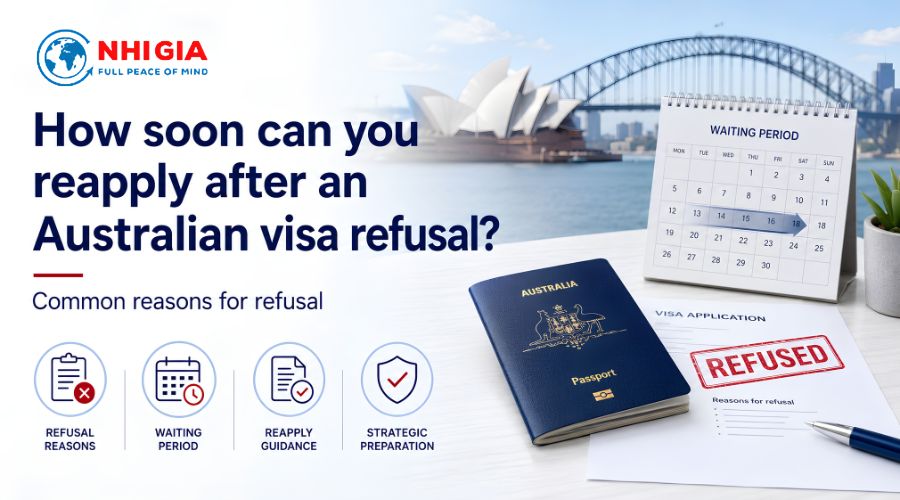
How Soon Can You Reapply After an Australian Visa Refusal?
In general, the Australian Department of Home Affairs does not impose one fixed waiting period for all visa refusal cases. Applicants may reapply when they are eligible and have prepared a stronger and more suitable dossier.
However, before reapplying, clients should carefully check:
- The refusal reasons stated in the decision letter;
- Whether the case has review rights;
- Whether any visa application restriction applies;
- Whether the new dossier has addressed the previous weaknesses;
- Whether travel purpose, finances, employment, ties to Vietnam and immigration history are now better demonstrated.
In serious cases involving bogus documents, false or misleading information, or failure to satisfy identity requirements, applicants may be affected by visa grant restrictions for a certain period. Therefore, after an Australian visa refusal, the first step should not be “reapply immediately,” but to carefully review the refusal reasons and reassess the entire dossier.
Why Can an Australian Visa Be Refused?
An Australian visa may be refused for many different reasons. For tourist, family visit or short-term business visitor applications, the assessing authority usually considers whether the applicant has a genuine travel purpose, sufficient financial capacity, strong reasons to return after the trip and truthful declarations.
Below are common reasons why an Australian visa application may be refused.
Insufficient or Unconvincing Financial Evidence
Financial evidence is one of the key factors in an Australian visa application. The assessing authority needs to see that the applicant can afford the trip, including flights, accommodation, meals, transport, insurance, personal itinerary and other expenses during the stay in Australia.
Financial evidence may be considered weak if:
- The account balance does not match the duration and purpose of travel;
- Income is unstable or cannot be properly proven;
- Bank transactions appear unusual, such as large deposits shortly before submission without clear explanation;
- There are no supporting documents for assets, employment or business activities;
- The financial sponsor cannot prove a suitable relationship and financial capacity.
Financial capacity is not only about how much money is in the account. More importantly, the source of funds must be reasonable, stable and consistent with the applicant’s circumstances.
Weak Ties to Vietnam
One of the key reasons for Australian visa refusal is failure to demonstrate sufficient reasons to return to Vietnam after the trip. For tourist, family visit or short-term business visitor visas, the assessing authority must be satisfied that the applicant’s stay is temporary and that they will leave Australia on time.
Ties to Vietnam may include:
- Stable employment in Vietnam;
- Income, employment contract or business activities;
- Family, children, parents or caregiving responsibilities;
- Assets such as property, company ownership, vehicles or valuable assets;
- Study, work or business plans after the trip;
- History of compliance with visas in other countries.
If the dossier only shows the desire to visit Australia but does not prove reasons to return, it may be considered insufficiently convincing.
Unclear Travel Purpose
Applicants must prove that their travel purpose matches the visa category. For a tourist visa, the purpose may be tourism, holiday, visiting friends or visiting relatives. For a short-term business visitor visa, the purpose may include attending conferences, meeting partners or undertaking permitted business visitor activities.
An application may be refused if:
- The itinerary is too vague or unreasonable;
- The invitation letter lacks clear details about purpose, timing, inviter or relationship with the applicant;
- The declared purpose is inconsistent with supporting documents;
- The proposed stay is too long compared with the stated purpose;
- The itinerary does not match financial capacity, employment or personal circumstances.
A clear itinerary does not need to be decorative, but it must be reasonable and consistent with the actual dossier.
Incomplete, Incorrect or Inconsistent Documents
Australian visas are assessed based on the information and evidence in the application. Therefore, missing documents, incorrect information or inconsistencies may increase the refusal risk.
Common issues include:
- Incorrect personal information, date of birth, passport number or travel history;
- Expired documents;
- Inaccurate translation or missing certification where required;
- Bank statements, employment confirmation, business registration or asset documents that do not match other information;
- Invitation letters, itineraries, flights or hotel bookings containing conflicting details;
- Failure to explain unusual points in the application.
A small error does not always lead to refusal, but several small inconsistencies may reduce the credibility of the dossier.
Weak Travel or Immigration History
Travel history is not a mandatory condition for being granted an Australian visa, but it can help strengthen an application. An applicant who has travelled to multiple countries, complied with stay periods and followed visa conditions may have an advantage in demonstrating compliance.
A dossier may be considered weaker if:
- The applicant has never travelled overseas;
- Travel history is limited or mainly to nearby countries;
- Previous visa refusals in other countries were not declared or explained;
- The applicant has overstayed, worked in breach of visa conditions or committed immigration violations;
- Travel history information does not match the application.
However, having limited travel history does not automatically mean an Australian visa will be refused. The key is to reasonably prove travel purpose, financial capacity, ties and honesty.
Previous Visa Breaches or Untruthful Declarations
If the applicant has previously breached visa conditions, overstayed, worked unlawfully, been removed, had a visa cancelled or provided false information in a past application, future Australian visa applications may be seriously affected.
In particular, if the dossier contains bogus documents or false or misleading information, the applicant may be refused and may be subject to a visa non-grant period under applicable rules. This is why all application information must be truthful, consistent and supported by suitable evidence.
If there is a history of breach or visa refusal, clients should not hide it. The proper approach is to declare it fully, explain clearly and provide evidence of rectification where available.
Is There a “Household Registration Blacklist” for Australian Visas?
It is not advisable to state that an applicant’s household registration is on a “blacklist” of the Australian immigration authority. This wording can be misleading and is not suitable for professional advisory content.
In practice, the assessing authority may consider various risk factors in an application, including immigration history, visa compliance, declared information, travel purpose, financial capacity, return ties and personal circumstances. Some localities or applicant profiles may be examined more closely based on past risk data, but it should not be described as a fixed legal “household registration blacklist.”
For Nhị Gia’s website content, a more accurate way to present this is: an application may be assessed as higher risk if the applicant has poor immigration history, unclear information, an unconvincing travel purpose or insufficient evidence of return ties.
What Should You Do After an Australian Visa Refusal?
After an Australian visa refusal, clients should not rush to reapply immediately. The first step is to analyze the refusal letter and identify the specific reasons.
Recommended steps include:
- Step 1: Read the refusal letter carefully. The refusal letter usually states why the application did not meet the requirements and whether there are review rights.
- Step 2: Identify the weaknesses in the dossier. The applicant should determine whether the weakness relates to finances, employment, ties, itinerary, invitation letter, immigration history or document consistency.
- Step 3: Do not reapply before addressing the issues. If the refusal reasons are not resolved, the new application may be refused again.
- Step 4: Prepare additional evidence. Depending on the case, clients may need to add financial documents, employment confirmation, asset evidence, explanation letters, invitation letters, itineraries or evidence of ties to Vietnam.
- Step 5: Check review rights if available. Some decisions may be reviewable within a specific timeframe. Clients should check the refusal letter carefully to avoid missing important deadlines.
Does an Australian Visa Refusal Affect Future Applications?
It can. A previous Australian visa refusal becomes part of the applicant’s immigration history. When reapplying, the applicant must truthfully declare the previous refusal if required in the application.
However, a previous refusal does not mean the next application will certainly be refused. If the applicant explains the previous refusal clearly, provides new evidence and demonstrates that the current dossier has improved, the assessment may be more favorable.
The key is that the post-refusal dossier must show real improvement. Simply changing travel dates, replacing hotel bookings or making the itinerary look nicer is usually not enough if the main issue relates to finances, ties or travel purpose.
Should You Reapply for an Australian Visa by Yourself After Refusal?
If the refusal was due to simple issues such as missing documents, unclear information or an unreasonable itinerary, the applicant may prepare a new application independently if they understand the requirements and can provide suitable evidence.
However, if the refusal involves more complex reasons such as doubts about travel purpose, unconvincing finances, weak ties, previous visa breaches, multiple refusals or inconsistent declarations, clients should seek advice before reapplying.
A post-refusal application needs to be handled more carefully than a first-time application. This is not the time to “try again and see,” because each additional refusal may further weaken the applicant’s record.
Australian Visa Refusal Consultation Service by Nhị Gia
Nhị Gia supports clients in reviewing previously refused Australian visa applications, analyzing refusal reasons and advising on a more suitable strategy for a new application based on each specific case.
With more than 20 years of experience in visa and international dossier support, Nhị Gia assists clients with:
- Reviewing and analyzing the Australian visa refusal letter;
- Identifying weaknesses in the previous application;
- Advising on whether to reapply or choose another handling direction;
- Guiding preparation of financial, employment, asset and Vietnam-tie evidence;
- Supporting itinerary planning, explanation letters and new dossier preparation;
- Reviewing consistency between the application form, documents and travel purpose;
- Tracking the application after submission;
- Maintaining confidentiality of clients’ personal information and application history.
Nhị Gia does not guarantee visa outcomes for every application, as the final decision rests with the Australian reviewing authority. However, proper review and preparation can help clients reduce errors, strengthen the application and avoid repeating the previous refusal reasons.
If you have recently been refused an Australian visa and are unsure when to reapply, why the application was refused or how to prepare a new dossier, please contact Nhị Gia for case-specific consultation.
Please contact Hotline 1900 6654 for Nhị Gia’s specialists to review the dossier and advise on a suitable next step.