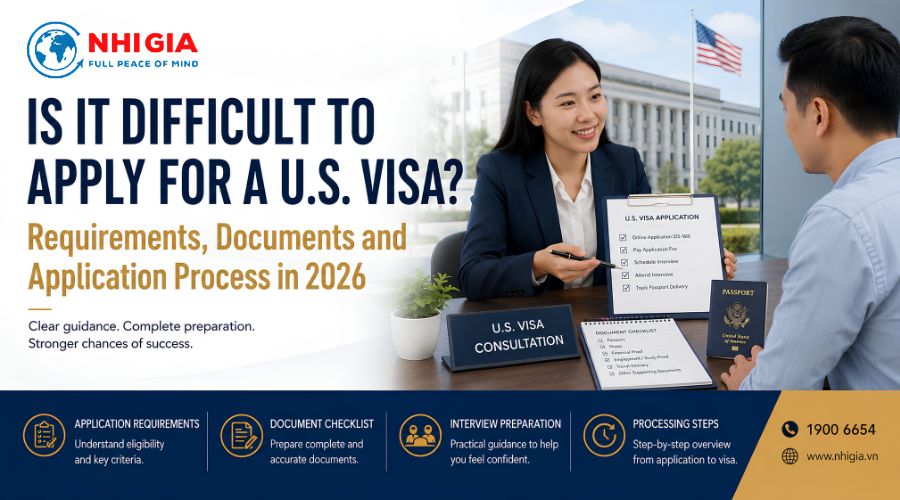
Is It Difficult to Apply for a U.S. Visa?
Applying for a U.S. visa cannot be described as “too difficult” for every case, but it does require careful preparation. For tourist, business or family visit visas, the consular officer will assess the travel purpose, financial capacity, ties to Vietnam, travel history, truthfulness of information and how the applicant answers during the interview.
A key difference with U.S. visa applications is that documents are not the only deciding factor. The interview plays a very important role. Applicants should answer briefly, clearly, directly and consistently with the information declared in the DS-160 form.
Therefore, a U.S. visa is not necessarily difficult if the applicant has a clear travel purpose, transparent documents, reasonable finances, convincing ties to Vietnam and proper interview preparation. On the other hand, a dossier lacking logic, inconsistent declarations or vague interview answers may increase the risk of refusal.
What Is a U.S. Visa?
A U.S. visa is issued by a U.S. consular authority to foreign nationals who wish to enter the United States for a specific purpose, such as tourism, business, study, work, family visit or immigration.
However, holding a U.S. visa does not guarantee entry into the United States. A visa allows the traveler to arrive at a U.S. port of entry and request permission to enter. The final decision on admission is made by U.S. border authorities at the port of entry.
Therefore, after being granted a visa, clients must still enter for the correct purpose, comply with the permitted stay period and follow visa conditions. Overstaying or using the visa for the wrong purpose may seriously affect future U.S. visa applications.
Common Types of U.S. Visas
U.S. visas are divided into two main groups: nonimmigrant visas and immigrant visas. Identifying the correct visa type is the first and very important step, as each visa category has different requirements, documents, procedures and purposes.
U.S. Nonimmigrant Visas
Nonimmigrant visas are for people who intend to travel to the United States for a temporary period and do not seek permanent residence at the time of application.
Common nonimmigrant visa types include:
- B-1 visa: for short-term business activities, conferences, meetings with partners or contract negotiations;
- B-2 visa: for tourism, vacation, family visits, medical treatment or certain suitable personal activities;
- B-1/B-2 visa: combining short-term business and tourism/family visit purposes;
- F/M visas: for study in the United States;
- J visa: for approved exchange visitor programs;
- C visa: for transit through the United States;
- D visa: for crewmembers;
- I visa: for foreign media representatives;
- Certain temporary work visas: for permitted employment in the United States, often requiring sponsorship or prior approval.
It is important to note that B-1/B-2 visas do not allow the applicant to work in the United States. If the purpose is employment, receiving salary or performing labor activities in the U.S., clients must check the appropriate work visa category.
U.S. Immigrant Visas
U.S. immigrant visas are for people who intend to live permanently in the United States. These applications are generally more complex than nonimmigrant visa applications and often involve sponsorship petitions, USCIS, NVC processing and immigrant visa interviews.
Common immigrant visa groups include:
- Family-sponsored immigrant visas;
- Spouse, fiancé(e), child or family-based categories depending on the case;
- Employment-based immigrant visas;
- Investment or other specific immigrant categories if eligible;
- Certain humanitarian or special programs as prescribed.
Each immigrant visa category has its own process, timeline and documentary requirements. Clients should not use a tourist visa checklist to prepare for an immigrant visa application, as these are completely different systems.
Why Is a U.S. Visa Often Considered Difficult?
U.S. visas are often considered difficult not because every application is refused, but because the assessment process requires a high level of clarity, truthfulness and consistency. The consular authority does not only review whether the applicant has documents, but also assesses whether the applicant is likely to enter for the stated purpose and leave the United States on time.
Reasons why U.S. visa applications require careful preparation include:
- Strict assessment process;
- In-person interview is an important step;
- Travel purpose must be clearly demonstrated;
- Finances and ties to Vietnam must be reasonable;
- Travel and visa history may be considered;
- Information in the DS-160 must be consistent with interview answers;
- Any indication of an intention to remain in the U.S. for an improper purpose may affect the result.
Consular officers often have limited time to assess an application during the interview. Therefore, answers that are too long, inconsistent or unclear may negatively affect the application.
Key Requirements When Applying for a U.S. Visa
Requirements for a U.S. visa vary depending on the visa category. However, for nonimmigrant visas such as B-1/B-2, clients should pay attention to the following factors:
Clear Travel Purpose
The applicant must clearly identify the purpose of travel to the United States: tourism, business, family visit, medical treatment, study or another purpose. The travel purpose must match the visa category being applied for.
For example, if applying for a B-2 visa for tourism or family visit, the itinerary should show planned activities, accommodation, expected travel dates and U.S. contact if any. If applying for a B-1 visa for business, the dossier should clearly show the business activities, inviting organization, working schedule and reason for traveling to the U.S.
Valid Passport
In general, the passport should be valid for at least 06 months beyond the intended stay in the United States, unless exempt under specific country agreements.
In addition, passport information must match the DS-160 form, interview appointment and supporting documents. Errors in name, passport number, date of birth or nationality may create issues for the application.
Suitable Financial Capacity
The applicant should demonstrate sufficient financial capacity to cover the U.S. trip, including flights, accommodation, meals, transport, insurance, personal expenses and other costs.
Financial capacity is not only about bank balance. The consular officer may consider income source, employment, assets, transaction history and whether the trip cost is reasonable compared with the applicant’s circumstances.
A strong financial profile should show:
- Stable income source;
- Suitable assets or savings;
- Reasonable trip cost;
- Clear financial sponsor if applicable;
- Financial information consistent with employment and personal circumstances.
Ties to Vietnam
For nonimmigrant visas, one important factor is showing reasons to return to Vietnam after the trip.
Ties may include:
- Stable employment;
- Business or commercial activities in Vietnam;
- Family, spouse, children or dependants requiring care;
- Assets, property, vehicles or investments;
- Study, work or business plans after the trip;
- History of timely travel compliance in other countries.
The clearer the ties, the stronger the basis for showing that the trip is temporary and for the stated purpose.
Accurate and Consistent DS-160 Declaration
The DS-160 is a mandatory online form for many U.S. nonimmigrant visa applications. Information in the DS-160 must be accurate, complete and consistent with the passport, itinerary, employment documents, financial evidence, U.S. contacts and travel history.
Common DS-160 mistakes include:
- Incorrect name, date of birth or passport number;
- Missing previous U.S. or international travel history;
- Incorrect information about relatives in the U.S.;
- Travel purpose inconsistent with the itinerary;
- Unclear employment information;
- Failure to declare previous visa refusals;
- Not saving the DS-160 confirmation code.
The DS-160 should not be completed casually or by guesswork. Incorrect information may make the interview much more difficult.
U.S. Nonimmigrant Visa Application Process in 2026
The U.S. visa process may change depending on timing, visa category and consular post. For common nonimmigrant visa categories such as B-1/B-2, the basic process generally includes the following steps:
Step 1: Identify the Correct Visa Category
Before starting the application, clients must identify the correct visa category based on travel purpose. For tourism or family visits, B-2 may be considered. For short-term business, partner meetings or conferences, B-1 may be considered. If the purpose is study or employment, another suitable visa category should be reviewed.
Step 2: Complete the DS-160 Form
The applicant must complete the DS-160 online with personal information, passport details, employment, education, travel history, relatives, travel purpose and other relevant information.
After completion, the system generates a DS-160 confirmation page with a barcode. The applicant should save and print this confirmation page for appointment scheduling and the interview.
Step 3: Pay the Visa Application Fee
The applicant must pay the visa application processing fee according to the visa category. For non-petition-based nonimmigrant visa categories such as B-1/B-2, the current processing fee is USD 185.
This is an application processing fee and is generally non-refundable whether the visa is granted or refused. Therefore, before payment, clients should carefully check the visa category, personal information and payment instructions on the designated appointment system.
Step 4: Schedule the Visa Interview
After completing the DS-160 and paying the fee, the applicant schedules an interview at the U.S. Embassy in Hanoi or the U.S. Consulate General in Ho Chi Minh City through the designated system.
Appointment wait time may vary depending on timing, visa category and interview location. If urgent travel is required, the applicant must still complete the DS-160, pay the fee and schedule the first available appointment before an expedited appointment request can be considered where eligible.
Step 5: Prepare Documents for the Interview
A typical U.S. visa interview dossier may include:
- Valid passport;
- DS-160 confirmation page;
- Interview appointment confirmation;
- Visa fee payment receipt or information if required;
- U.S. visa photo in the required format if requested by the system or consular authority;
- Documents proving travel purpose;
- Documents proving employment, finances and ties to Vietnam;
- Invitation letter, itinerary, bookings or U.S. family/contact information if any;
- Additional documents depending on the visa category.
Not every document may be requested during the interview, but proper preparation helps the applicant answer confidently and provide evidence if asked by the consular officer.
Step 6: Attend the U.S. Visa Interview
The interview is an important step in the U.S. visa application process. The applicant should arrive on time, bring the required documents and answer truthfully and clearly.
Interview principles include:
- Answer the question directly;
- Do not memorize answers mechanically;
- Do not volunteer unnecessary information;
- Do not hide visa or travel history;
- Remain calm and polite;
- Answers must match the DS-160 and supporting documents.
If approved, the passport may be retained for visa issuance or processed according to the current procedure. If administrative processing or additional information is required, the result may take longer.
Common Reasons for U.S. Visa Refusal
A U.S. visa may be refused for many reasons. For nonimmigrant visas, common reasons include:
- Unclear travel purpose;
- Failure to prove ties to return to Vietnam;
- Finances not matching the itinerary;
- Unstable employment or income;
- Inconsistency between the DS-160 and interview answers;
- Weak travel history or previous visa violations;
- Having relatives in the U.S. without clear declaration;
- Previous visa refusal without proper explanation;
- Vague, inconsistent or unconfident interview answers;
- Indications of intent to remain in the U.S. for an improper purpose.
A U.S. visa refusal does not mean the applicant can never reapply. However, if the new application does not address the previous weaknesses, the risk of another refusal remains high.
Can You Reapply After a U.S. Visa Refusal?
Applicants may reapply for a U.S. visa after refusal. However, it is important to understand the refusal reason and prepare a stronger new application.
Before reapplying, clients should:
- Review the information declared in the previous DS-160;
- Assess possible reasons for refusal;
- Recheck the travel purpose;
- Add stronger financial, employment or tie evidence if needed;
- Prepare clearer interview answers;
- Avoid incorrect declarations or hiding the previous refusal.
Reapplying simply in the hope of meeting an easier consular officer is not a good strategy. Evidence and consistency matter more than luck.
Tips for Preparing a U.S. Visa Application
To strengthen a U.S. visa application, clients should note:
- Identify the correct visa category before completing the DS-160;
- Complete the DS-160 carefully, accurately and consistently;
- Prepare financial evidence suitable for the itinerary;
- Clearly prove employment, income and ties to Vietnam;
- Keep the itinerary realistic, especially if the profile is not strong;
- Declare relatives in the U.S. truthfully if any;
- Do not create fake documents or misrepresent visa history;
- Do not buy non-refundable flights before obtaining the visa;
- Prepare for the interview by understanding the dossier, not memorizing a script;
- Prepare early, especially during peak seasons or long appointment wait times.
A U.S. visa dossier does not need excessive decoration. What matters most is truthfulness, clarity, reasonableness and consistency.
U.S. Visa Support Service by Nhi Gia
Applying for a U.S. visa requires careful preparation, especially for clients who have never traveled abroad, have previous visa refusals, have relatives in the U.S., have complex financial profiles or are unsure how to answer interview questions.
With more than 20 years of experience in visa and international dossier support, Nhị Gia assists clients in preparing U.S. visa applications based on specific purposes such as tourism, family visit, business, study or other needs.
Nhị Gia supports clients with:
- Advising on the suitable U.S. visa category based on travel purpose;
- Reviewing strengths and weaknesses of the dossier;
- Guiding preparation of financial, employment, asset and Vietnam-tie documents;
- Supporting DS-160 completion based on client-provided information;
- Guiding fee payment and interview appointment scheduling according to the current process;
- Reviewing information before the interview;
- Advising on truthful, clear and focused interview answers;
- Supporting clients with previous visa refusals in reassessing their dossiers before reapplication;
- Maintaining confidentiality of clients’ personal information and dossiers.
Nhị Gia does not guarantee visa outcomes for every application, as the final decision belongs to the U.S. consular officer. However, preparing the correct visa category, declaring information accurately and understanding the dossier before the interview can help clients reduce errors and strengthen the application.
Nhị Gia Service Timeline
The waiting time for the interview appointment, post-interview assessment and visa result delivery depends on the visa category, interview location, application volume, administrative processing if required and regulations of the U.S. consular authority.
When using Nhị Gia’s service, the actual timeline does not only include the consular processing time. The service process also includes consultation, dossier review, document preparation guidance, DS-160 completion, fee payment, interview scheduling, pre-interview review and result tracking support where needed.
Nhị Gia will advise the estimated timeline after reviewing the travel purpose, dossier status and appointment availability at the time of service. The service timeline should not be understood as always equal to the consular authority’s processing time.
Contact Nhị Gia for U.S. Visa Consultation
If you are planning to apply for a U.S. visa for tourism, family visit, business, study or need to reassess your dossier after a previous refusal, please contact Nhị Gia for case-specific consultation.
Please contact Hotline 1900 6654 or email info@nhigia.vn for detailed support from Nhị Gia’s specialists.