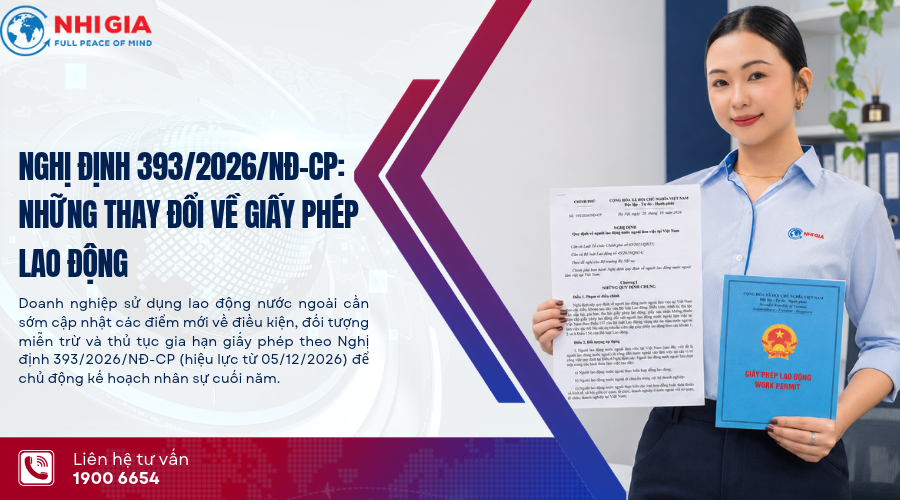
Effective December 5th, 2026, Decree No. 393/2026/ND-CP officially comes into force, replacing Decree No. 219/2025/ND-CP on foreign employees working in Vietnam.
The new Decree introduces several notable changes concerning eligibility requirements for foreign employees, work permit exemptions, work permit extension procedures, and documentation management.
For businesses employing foreign Experts, Managers, or other foreign personnel in Vietnam, staying informed about these regulatory changes will help HR/Admin teams proactively plan recruitment, work permit extensions, and year-end workforce arrangements.
Overview of Decree 393/2026/ND-CP
Decree No. 393/2026/ND-CP was issued by the Government of Vietnam on October 20th, 2026, regulating foreign employees working in Vietnam.
The key provisions cover:
- Eligibility requirements for foreign employees working in Vietnam.
- Categories of foreign employees exempt from work permit requirements.
- Documentation, processes, and procedures for work permit issuance, reissuance, and extension.
- Documentation and procedures for issuing and extending Work Permit Exemption Certificates.
- Employers’ management responsibilities and transitional provisions.
Important Date: December 5th, 2026, marks the effective date of Decree 393/2026/ND-CP and the expiration of Decree 219/2025/ND-CP.
However, this does not mean that all previously issued work permits must be reapplied for.
Key Changes Affecting Businesses Employing Foreign Workers
Expansion of Work Permit Exemption Categories
One of the most significant changes under Decree 393/2026/ND-CP is the expansion of work permit exemption categories from 15 to 18.
Some newly introduced or revised categories include:
- Foreign nationals holding special visa exemption cards in accordance with applicable regulations.
- Experts working in strategic technology sectors and other eligible individuals who meet the prescribed requirements.
- Professionals recruited under the national program for artificial intelligence workforce development.
- Certain categories of foreign personnel working in education and specialized professional activities.
However, being exempt from work permit requirements does not necessarily mean being exempt from all administrative procedures.
Depending on the applicable category, employers may still be required to apply for a Work Permit Exemption Certificate or submit the relevant notification to the competent authority.
Therefore, businesses should carefully identify the applicable legal grounds and supporting documentation for each case rather than relying solely on job titles or entry purposes.

Revised Eligibility Requirements for Experts and Executive Directors
Decree 393 introduces additional provisions and revisions to the criteria for determining eligibility for Experts, Executive Directors, and other employment categories.
For Experts, the new regulations provide additional grounds for assessing eligibility based on educational qualifications, professional specialization, and relevant work experience.
Important Note: Certain cases may qualify based on work experience relevant to the intended position in Vietnam. However, employers must carefully verify the specific eligibility requirements under Article 4 and the supporting documents prescribed in Article 20.
For certain categories of Executive Directors specified under the new regulations, the minimum work experience requirement has been reduced from three years to two years.
Key Consideration for HR Teams: Not every position titled “Director,” “Manager,” or “Expert” automatically satisfies the applicable eligibility requirements.
Job classification must be based on actual responsibilities, organizational structure, professional experience, and relevant supporting documentation.
Changes to Intra-Company Transfer Arrangements
Under the new regulations, the Intra-Company Transfer employment arrangement no longer applies to Technical Workers as it previously did.
This is an important change for businesses employing technical specialists, project personnel, or employees assigned to Vietnam by overseas companies.
Businesses should review:
- The employment arrangement declared in the application.
- The employee’s actual job position and responsibilities in Vietnam.
- Supporting documents demonstrating recruitment or assignment by the overseas company.
- The eligibility requirements applicable to each position.
For Technical Workers under Intra-Company Transfer arrangements who were issued relevant documents before the new Decree takes effect, businesses should review the transitional provisions under Article 35.
Employers should not automatically change job titles or employment arrangements in existing applications without first establishing the appropriate legal grounds.
Shorter Processing Time for Work Permit Extensions
Under Article 29 of Decree 393/2026/ND-CP, the processing time for work permit extensions has been reduced from 10 working days to 5 working days from the date the competent authority receives a complete and valid application.
Regarding application submission timelines, businesses should note:
- Extension applications must be submitted at least 10 working days before the work permit expires.
- Applications must not be submitted more than 90 days before the work permit’s expiration date.
In addition, the documentation requirements for work permit extensions have been simplified. Notably, a health examination certificate is no longer required as part of the extension application under the new regulations.
However, the five-working-day processing period applies only after the competent authority has received a complete and valid application.
It does not guarantee that the entire process, including document preparation, translation, legalization, or submission of supplementary documents, will be completed within five working days.
Strengthened Information Management and Reporting Responsibilities
Decree 393 continues to emphasize employers’ responsibilities in monitoring and managing foreign employees.
Businesses should pay particular attention to the following obligations:
- Submitting periodic reports on the employment of foreign workers as required by law.
- Providing notifications when changes to work locations fall within the categories requiring notification.
- Maintaining accurate information regarding foreign employees, job positions, and employment periods.
- Properly retaining supporting documents for inspection and verification purposes.
For changes involving regular or long-term work locations that require notification, the Decree specifies that notification must be submitted at least three working days in advance.
Maintaining centralized employee records can help HR/Admin teams manage foreign personnel more effectively, particularly when employees are transferred between branches, workplaces, or projects.
Do Work Permits Issued Under Decree 219/2025/ND-CP Remain Valid?
Yes. Work permits and Work Permit Exemption Certificates issued under the regulations specified in Article 35 of Decree 393 remain valid until their respective expiration dates.
This is particularly important for businesses planning their foreign employee documentation.
The effective date of December 5th, 2026, does not mean that all foreign employees must apply for new work permits.
Instead, businesses should classify applications according to their current status.
Case 1: Previously Issued Documents That Remain Valid
Businesses should continue monitoring expiration dates, job positions, employment arrangements, and other information stated on existing work permits or exemption certificates.
Where reissuance, extension, or information updates are required, the relevant procedures must be followed.
Case 2: Applications Submitted Before December 5th, 2026
Under Clause 2, Article 35 of Decree 393, applications covered by the transitional provisions and submitted before the Decree’s effective date will continue to be processed in accordance with Decree 219/2025/ND-CP.
Case 3: Applications to Be Submitted From December 5th, 2026
Businesses must review eligibility requirements, application forms, supporting documents, and procedures in accordance with Decree 393/2026/ND-CP.
Particular attention should be given to applications involving Experts, Executive Directors, Technical Workers, and foreign employees eligible for work permit exemptions.
HR/Admin Checklist Before December 5th, 2026
To minimize the risk of applying outdated regulations, Nhi Gia recommends that businesses review their foreign employee documentation through the following five steps.
Step 1 – Review the Foreign Employee List
Compile a comprehensive list of foreign employees, including their full names, nationalities, job titles, employment arrangements, and expiration dates of existing work permits or exemption certificates.
Step 2 – Classify Application Status
Identify applications that have already been approved, are currently being processed, are approaching extension deadlines, are planned for new submission, or fall under work permit exemption categories.
Step 3 – Verify Eligibility Requirements for Each Position
Review educational qualifications, employment experience certificates, appointment decisions, and the proposed employment arrangements.
Step 4 – Monitor Important Deadlines
Establish a tracking schedule for new applications, reissuance, and extensions, while identifying cases requiring mandatory notifications.
Step 5 – Prepare Appropriate Application Strategies
For complex cases involving professional experience, job classifications, workplace changes, or transitional provisions, businesses should determine the appropriate approach before submitting applications.
A centralized tracking system is particularly useful for businesses employing large numbers of foreign personnel or employees who frequently move between different work locations.

Frequently Asked Questions About Decree 393/2026/ND-CP
When Does Decree 393/2026/ND-CP Take Effect?
Decree 393/2026/ND-CP takes effect on December 5th, 2026, replacing Decree 219/2025/ND-CP.
Do Foreign Employees With Existing Work Permits Need to Reapply?
Not all foreign employees are required to reapply.
Work permits and Work Permit Exemption Certificates covered by the transitional provisions remain valid until their expiration dates.
How Long Does It Take to Extend a Work Permit Under Decree 393?
The processing time is five working days from the date the competent authority receives a complete and valid extension application.
When Should a Work Permit Extension Application Be Submitted?
Under Article 29, an extension application must be submitted at least 10 working days, but no more than 90 days, before the work permit expires.
Do Foreign Employees Exempt From Work Permit Requirements Still Need to Complete Administrative Procedures?
It depends on the applicable exemption category.
Certain foreign employees must obtain a Work Permit Exemption Certificate, while others are required to complete the prescribed notification procedures.
How Nhi Gia Supports Businesses With Foreign Employee Documentation
Regulatory changes provide an important opportunity for businesses to review their foreign employee documentation, particularly applications currently pending approval or scheduled for extension in the coming months.

Nhi Gia provides professional support to businesses in the following areas:
- Consultation and assistance with work permit issuance, reissuance, and extension applications.
- Reviewing eligibility requirements and supporting documents for each job position.
- Assistance with Work Permit Exemption Certificate applications.
- Consultation on related visa, immigration, and Temporary Residence Card (TRC) procedures.
Does your business have foreign employee applications that need to be reviewed before December 5th, 2026?
Contact Nhi Gia for professional consultation and tailored solutions based on your company’s specific documentation requirements and application status.