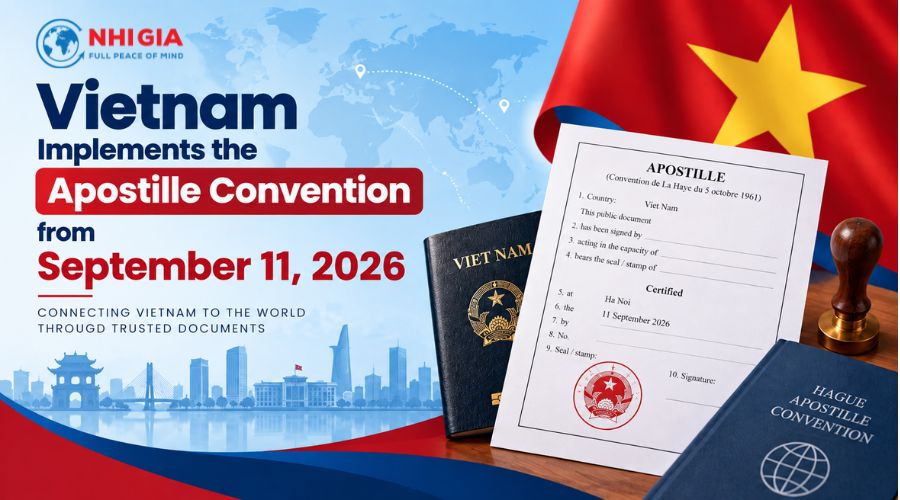
September 11, 2026 marks an important change in the use of public documents between Vietnam and most Contracting Parties to the 1961 Hague Convention Abolishing the Requirement of Legalisation for Foreign Public Documents, commonly known as the Apostille Convention.
The Convention’s entry into force in Vietnam does more than simplify an administrative procedure. It may also reduce transaction costs and facilitate investment, trade, foreign-worker recruitment, and the expansion of Vietnamese enterprises into international markets.
However, the Apostille Convention does not mean that every foreign document will automatically be accepted in Vietnam. Enterprises must understand the Convention’s scope, exclusions, translation requirements, and sector-specific regulations to benefit from the mechanism without creating additional document-related risks.
What is an Apostille?
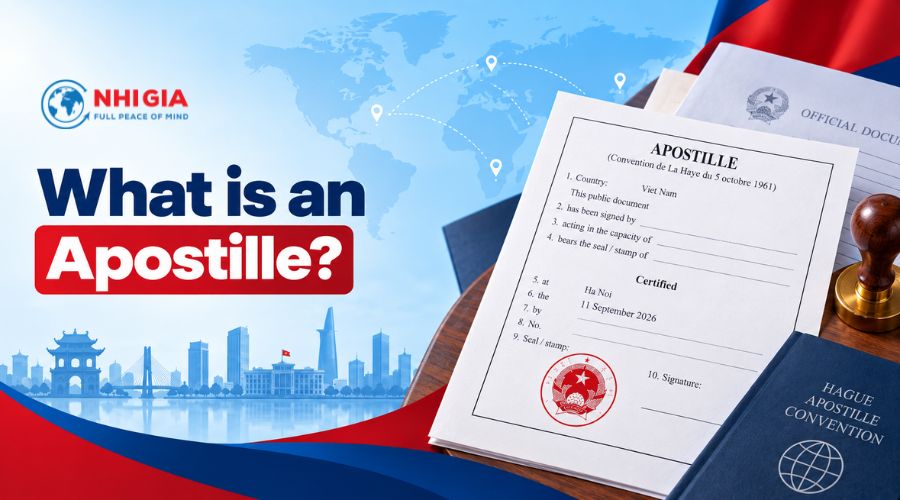
Under Clause 2, Article 3 of Government Decree No. 293/2026/ND-CP, an Apostille is a certificate issued by a competent authority of Vietnam or a Contracting Party to authenticate the origin of a public document.
The certification covers the authenticity of the signature, the capacity in which the signatory acted, the authority of the signatory, and the identity of the seal or stamp affixed to the public document, where applicable.
Under Article 4 of the same Decree, an Apostille does not certify the content or form of a public document. Therefore, the issuance of an Apostille does not mean that the receiving authority must automatically recognize the entire content of the document.
Other requirements relating to notarization, certification, translation, or sector-specific conditions must still be reviewed in accordance with the applicable regulations.
Key dates of the Apostille Convention
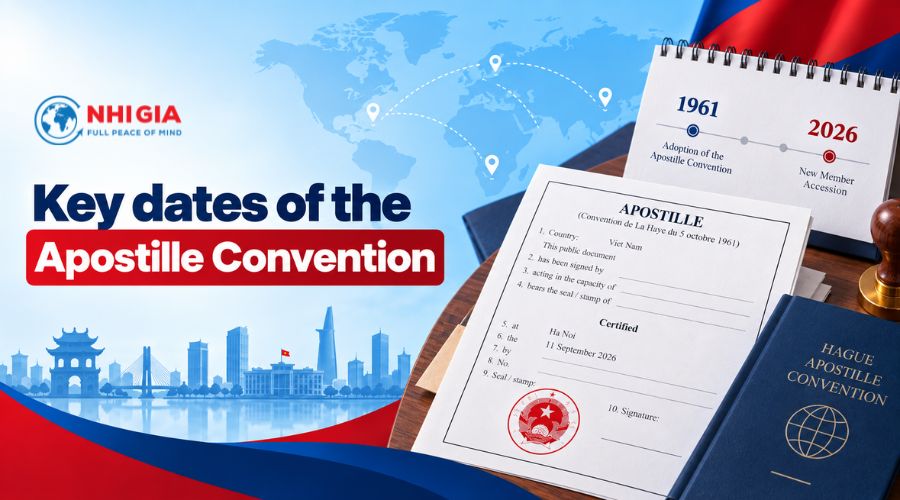
The Convention was signed at The Hague on October 5, 1961, and entered into force internationally on January 24, 1965. Its core objective is to abolish the traditional requirement for diplomatic or consular legalization of public documents issued in one Contracting Party for use in another Contracting Party.
According to the official status information published by the Hague Conference on Private International Law, Vietnam deposited its instrument of accession to the Convention on December 31, 2025. Following the period during which Contracting Parties could raise objections under Article 12, the Convention entered into force in relation to Vietnam on September 11, 2026.
As of June 30, 2026, the Convention had 130 Contracting Parties, according to the HCCH Apostille Section.
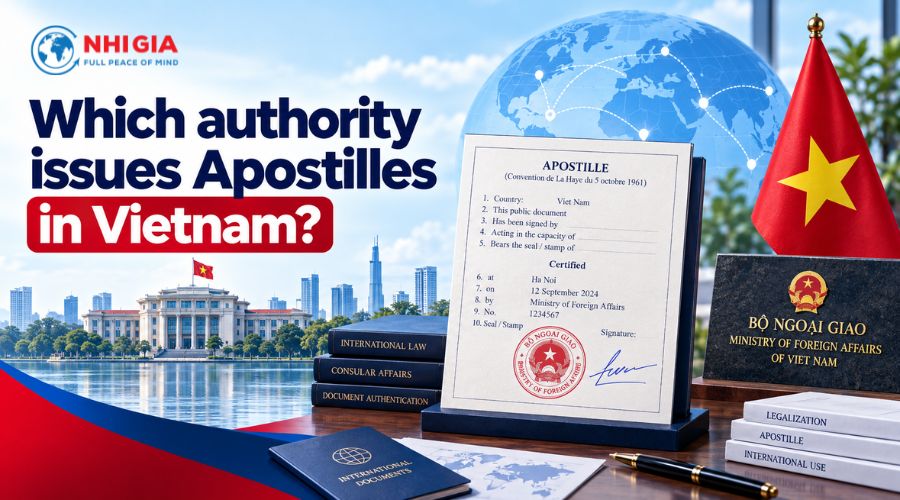
Under Article 6 of Decree No. 293/2026/ND-CP, the Ministry of Foreign Affairs is the competent authority responsible for issuing Apostilles in Vietnam. Under the current implementation arrangement, applications are received and results are returned through the following channels:
- The Consular Department of the Ministry of Foreign Affairs in Hanoi.
- The Department of Foreign Affairs of Ho Chi Minh City.
A specific issue requiring attention is that Germany, Austria, and the Czech Republic have notified their objections to Vietnam’s accession under Article 12(2). Therefore, the Convention is not currently in force between Vietnam and these three countries.
Public documents used between Vietnam and Germany, Austria, or the Czech Republic cannot rely on the Apostille mechanism and must continue to follow the procedure accepted by the relevant authorities of each country, commonly involving authentication and consular legalization.
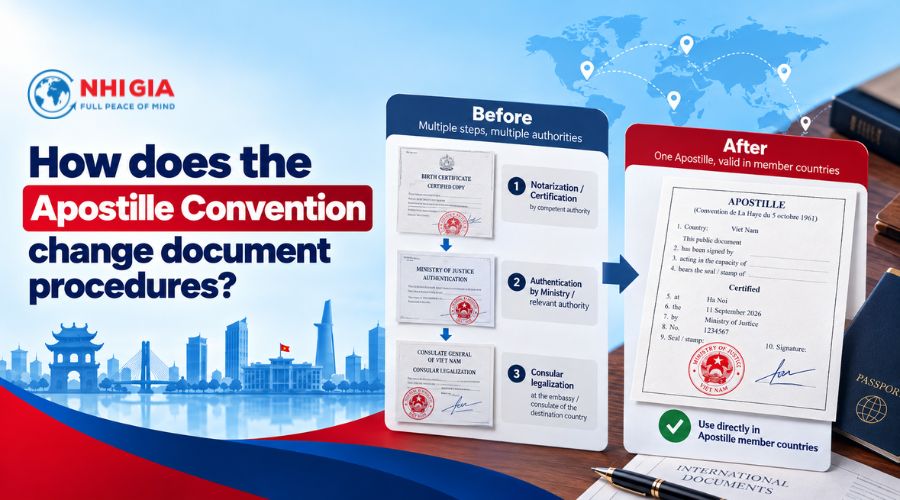
How does the Apostille Convention change document procedures?
Before September 11, 2026, a foreign public document intended for use in Vietnam would generally have to pass through multiple layers of authentication. These could include certification by the competent authority in the issuing country, authentication by that country’s Ministry of Foreign Affairs, and legalization at the Embassy or Consulate General of Vietnam.
Vietnamese public documents intended for use abroad would often be subject to a similar chain of procedures.
Under the Apostille mechanism, for relations between Vietnam and a Contracting Party that has not objected to Vietnam’s accession, the traditional chain of consular legalization is, in principle, replaced by a single Apostille issued by the competent authority in the country where the document originated.
An Apostille authenticates three principal elements:
- The authenticity of the signature.
- The capacity in which the signatory acted.
- The identity of the seal or stamp affixed to the document.
An Apostille does not certify the content of the document. It does not establish the academic validity of a degree, confirm actual work experience, or require the receiving authority to recognize the professional value of the document.
The Convention primarily applies to the following categories of public documents:
- Documents issued by judicial authorities.
- Administrative documents.
- Notarial acts.
- Official certificates attached to documents signed by private individuals.
The Convention does not apply to documents issued by diplomatic or consular agents or to administrative documents directly related to commercial or customs operations.
An employment contract, employment-experience certificate, or internal training certificate issued by a private enterprise does not automatically become a public document. To obtain an Apostille, the signature on such a document may first need to be notarized or certified. The competent authority may then issue an Apostille in relation to that notarization or certification, rather than certifying the substantive content of the original document.
If your enterprise has not yet determined whether a document qualifies for an Apostille or requires prior notarization or certification, contact Nhị Gia at 1900 6654 for document review and guidance on the appropriate procedure.
Benefits of the Apostille Convention for Vietnamese enterprises
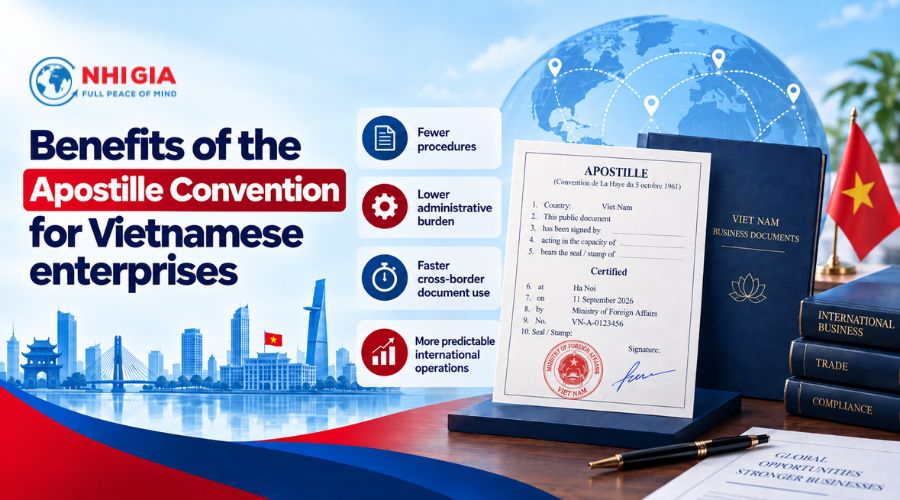
For Vietnamese enterprises, the Apostille mechanism may create practical advantages at various stages, from reducing the number of processing authorities and intermediary costs to shortening the time required to prepare international documents.
Fewer processing authorities and lower intermediary costs
The most immediate benefit is the reduction in processing stages and intermediary costs. For eligible documents, enterprises may no longer need to complete the entire chain of diplomatic authentication and consular legalization.
Travel expenses, authorization costs, international courier charges, and service fees payable to diplomatic missions may consequently be reduced.
Shorter processing time and lower administrative workload
The preparation of investment and employment documents may also become more efficient. This is particularly relevant to foreign-invested enterprises bringing experts, managers, and technical workers into Vietnam.
The mechanism may also benefit Vietnamese enterprises sending personnel abroad, educational institutions recruiting international teachers, healthcare facilities employing foreign doctors, and enterprises carrying out mergers, acquisitions, or the establishment of legal entities in multiple jurisdictions.
Greater procedural predictability
The Apostille mechanism may improve procedural predictability. Instead of researching the requirements of each diplomatic mission, enterprises can focus on the competent authority issuing the Apostille in the country of origin.
Where electronic Apostilles and electronic registers are available, verifying the origin and authenticity of a certificate may also become more convenient.
Greater legal interoperability
At a broader level, Vietnam’s participation in the Convention strengthens legal interoperability with major investment and labor markets, including the United States, the United Kingdom, Australia, Canada, Japan, South Korea, Singapore, China, India, and various European countries.
This may support the business environment, cross-border personnel mobility, and international investment activities.
How should enterprises take advantage of the Apostille Convention?
To use the Apostille mechanism effectively, enterprises should review their entire international-document workflow and standardize it according to the document category, destination country, and requirements of the receiving authority.
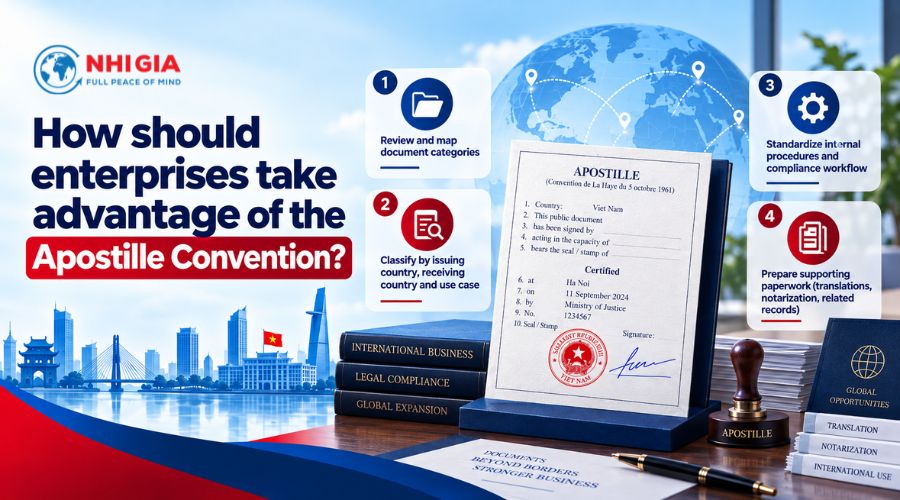
Review and classify documents
Enterprises should first review the “document map” used in their international operations. This may include corporate records, business registration certificates, charters, resolutions, powers of attorney, tax documents, degrees, police clearance certificates, birth certificates, marriage certificates, and employment-experience certificates.
Each document should be classified according to at least five factors:
- The country where it was issued.
- The country where it will be used.
- Whether it qualifies as a public document.
- The competent authority responsible for issuing the Apostille.
- Additional requirements imposed by the receiving authority.
Enterprises should not only check whether both countries are Contracting Parties. The Convention may not be in force between two countries because one of them has objected to the other’s accession.
Amend internal procedures and foreign-worker employment contracts
Enterprises should also revise their internal procedures and foreign-worker employment documentation. Recruitment checklists should identify which documents require only an Apostille, which documents must be notarized before an Apostille can be issued, which documents require a Vietnamese translation, and which documents remain subject to consular legalization.
Verify sector-specific requirements
Enterprises must continue to verify sector-specific requirements. An Apostille authenticates the signature, seal, and capacity of the signatory. It does not eliminate requirements concerning translation, certification of translations, recognition of qualifications, verification of educational institutions, or work-permit conditions.
Enterprises reviewing personnel records, degrees, or documents intended for use abroad may contact Nhị Gia at 1900 6654 for assistance in checking Apostille, translation, notarization, and consular legalization requirements.
Build a document database
Enterprises operating in multiple countries should build a country-specific database containing information on Apostille authorities, paper or electronic formats, processing times, fees, online submission options, and verification methods.
Such a database can become an important operational asset, reducing reliance on manual, case-by-case processing.
Vietnam’s implementation of the Apostille Convention from September 11, 2026 is an important procedural reform that may reduce the time, cost, and administrative burden associated with the international circulation of public documents.
The greatest operational advantage will likely belong to enterprises that standardize their workflows early, digitize document data, and move from routine document processing toward cross-border compliance management.
For visa and work-permit services, the Apostille mechanism does not eliminate the need for professional support. Instead, it increases the importance of correctly classifying documents, checking whether the Convention applies between the relevant countries, identifying exclusions, and integrating Apostille procedures with translation, notarization, qualification recognition, work permits, and temporary residence cards.
Frequently asked questions
What is the difference between an Apostille and consular legalization?
An Apostille is issued by the competent authority in the country where the document originated. Consular legalization is carried out in the country where the document will be used.
Where the two countries have an applicable relationship under the Convention and the document satisfies the relevant requirements, an Apostille replaces the consular legalization stage. It does not replace translation or sector-specific procedures.
Where does the Apostille Convention apply?
The Convention applies between Contracting Parties, subject to the applicable entry-into-force date and any objection to accession.
The HCCH currently lists 130 Contracting Parties. For Vietnam, the parties, territories, and document categories involved should be checked individually, particularly in relation to Germany, Austria, the Czech Republic, and Thailand.
Which authority issues Apostilles in Vietnam?
The Ministry of Foreign Affairs is the competent authority for issuing Apostilles in Vietnam. Under the current implementation arrangement, applications may be submitted and results collected through the Consular Department in Hanoi and the Department of Foreign Affairs of Ho Chi Minh City.
Vietnamese embassies and consulates abroad do not issue Apostilles for Vietnamese documents. Applicants should check the Ministry of Foreign Affairs’ official information before submitting an application.
Enterprises and individuals requiring assistance with Apostille, notarization, certification, or consular legalization procedures may contact Nhị Gia at 1900 6654. Nhị Gia can review the document type, destination country, and requirements of the receiving authority before the dossier is submitted.
Official sources:
- Government Portal: Decree No. 293/2026/ND-CP
- HCCH Apostille Section
- HCCH Convention Status Table
- Department of Foreign Affairs of Ho Chi Minh City