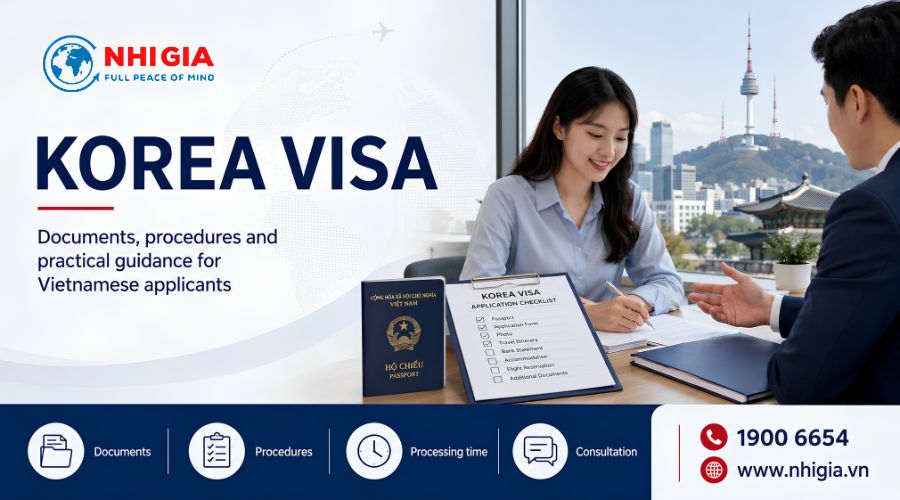
What Is a Korea Visa?
A Korea visa is a visa issued by the competent Korean authority to foreign nationals who wish to enter Korea for purposes such as tourism, business, commercial activities, family visit, study, work, transit or other suitable purposes.
Depending on the travel purpose, the applicant must apply for the corresponding visa category. Choosing the wrong visa type may cause the application to be inconsistent with the entry purpose, require additional documents or affect the review process.
It should be noted that being granted a visa does not automatically guarantee entry into Korea in all cases. Upon arrival, the competent Korean authority may still check the entry purpose, related documents and decide whether to allow entry under applicable regulations.
Common Types of Korea Visas
Korea visas are classified by number of entries, duration of stay and entry purpose.
By number of entries, visas may include:
- Single-entry visa: Allows one entry within the granted visa validity.
- Multiple-entry visa: Allows multiple entries during the visa validity if conditions are met.
- Double-entry visa: Applies to certain cases if granted by the competent authority.
By entry purpose, common Korea visa groups include:
| Visa group | Main purpose |
| Tourist visa | For applicants traveling to Korea for tourism, sightseeing, vacation or suitable short-term personal activities |
| Family visit visa | For applicants visiting relatives, family members or attending suitable family occasions in Korea |
| Business/commercial visa | For applicants traveling to Korea for meetings, partner visits, market surveys, conferences or short-term business activities |
| Student visa | For students or participants in academic or training programs in Korea |
| Work visa | For applicants entering Korea for employment under approval from the competent authority |
| Transit visa | For certain transit cases through Korea if a visa is required |
| Diplomatic/official visa | For diplomatic, official or corresponding purposes |
| Long-term stay visa | For long-term residence purposes such as study, employment, family reunion, investment or other suitable purposes |
The suitable visa type should be determined based on travel purpose, expected stay duration, personal dossier and regulations at the time of application.
What Documents Are Required for a Korea Visa Application?
Korea visa documents vary depending on visa type, travel purpose, submission location, personal status, employment, financial capacity, travel history and requirements at the time of application.
For common categories such as tourism, business, commercial activities or family visit, applicants generally need to prepare the following document groups:
Personal Documents
- Original passport with suitable validity, generally at least 06 months remaining;
- Previous passports if they contain relevant visa or travel history;
- Korea visa application form using the current template;
- Visa photo meeting requirements, usually white background, 3.5 x 4.5 cm, taken recently;
- Citizen ID card or corresponding identity document;
- Residence information confirmation or documents proving residence if required;
- Birth certificate, marriage certificate or relevant civil status documents if relationship proof is required.
Employment or Study Documents
Depending on the applicant’s status, documents may include:
- Employment contract;
- Employment confirmation letter;
- Leave approval letter or business trip assignment decision;
- Social insurance or documents proving employment history if required;
- Payslips, salary bank statements or income documents;
- Business registration certificate, business documents or tax records if the applicant owns a business;
- Retirement documents if the applicant is retired;
- Student confirmation, student card or related documents if the applicant is a student;
- Documents proving occupation or income source if the applicant is self-employed, a homemaker or freelancer.
Financial Documents
Financial documents help demonstrate the applicant’s ability to cover the trip and financial situation. Depending on the case, documents may include:
- Savings book or balance confirmation;
- Bank statements;
- Salary bank statements;
- Property ownership documents if any;
- Income, business, rental income or other lawful income records;
- Financial documents of the sponsor if the trip is financially sponsored.
Travel Documents
Depending on the visa purpose, applicants may need to prepare:
- Intended itinerary in Korea;
- Flight or transportation information;
- Accommodation information or hotel booking if required;
- Invitation letter if traveling for business, commercial activities, family visit or event attendance;
- Documents proving travel purpose;
- Documents proving relationship with the inviter if visiting family.
Applicants should be cautious about purchasing non-refundable flight tickets or services before obtaining the visa result. In many cases, intended itinerary, accommodation information or booking details may be used to support the travel plan, but purchased tickets or hotel bookings should not be considered a guarantee of visa approval.
Korea Visa Requirements
Korea visa requirements depend on the visa category and entry purpose. In general, applicants should prepare a dossier that clearly shows the travel purpose, suitable financial capacity, consistent personal information and plan to return to Vietnam or continue the journey after staying in Korea.
Commonly reviewed factors include:
- Clear entry purpose consistent with the requested visa type;
- Consistent personal, employment, financial and travel documents;
- No indication of improper entry purpose or illegal stay;
- Not falling under restricted entry cases;
- Documents proving travel purpose such as itinerary, invitation letter, study documents, business documents or family documents if required;
- Financial ability suitable for the stay duration and purpose;
- Employment, family, study or asset ties in Vietnam if the dossier needs to demonstrate return plan.
Each visa category has its own requirements. Therefore, applicants should check the correct visa type before preparing documents.
Korea Visa Application Process
The Korea visa application process may vary depending on visa type, submission location and regulations at the time of application. In general, applicants need to follow the basic steps below:
Step 1: Identify the Suitable Visa Category
Applicants should clearly identify whether the entry purpose is tourism, business, family visit, study, work, transit or another purpose to select the correct visa category.
Step 2: Prepare the Documents
Documents must be prepared according to the visa category. Information in the passport, visa application form, employment documents, financial documents, itinerary, invitation letter and accommodation details must be consistent.
Step 3: Make an Appointment and Submit the Application
Depending on submission location and rules at the time of application, applicants may need to make an appointment before visiting the visa application center or competent authority. When submitting, the applicant should bring complete documents according to instructions and pay applicable fees.
Step 4: Track the Application and Supplement Documents if Requested
After submission, the applicant tracks the processing status according to guidance from the center or receiving authority. During review, the competent authority may request additional documents, explanations or an interview if necessary.
Step 5: Collect the Result and Check the Visa
When the result is available, the applicant collects the passport through the registered method. If the visa is granted, the applicant should carefully check visa information such as full name, passport number, visa type, visa validity, number of entries and duration of stay.
Is an Interview Required for a Korea Visa?
Not every Korea visa application requires an interview. However, during the review process, the competent authority may request additional documents, explanations or an interview if necessary.
Therefore, applicants should not assume that using a service means an interview will definitely not be required. Whether an interview is required depends on the visa type, actual dossier and requirements of the reviewing authority.
How Long Does a Korea Visa Application Take?
Korea visa processing time depends on visa category, submission location, dossier status, appointment availability, additional requests and submission timing. It is not a fixed timeline applicable to all cases.
According to reference information from the Korea Visa Application Center, processing time for some common categories may include:
| Application group | Reference processing time |
| Tourist visa through a designated travel agency | Around 06 working days |
| Tourist visa through a registered travel agency | Around 09 working days |
| Individual tourist visa | Around 16 working days |
| Short-term business, meeting or conference visa | Around 10 working days depending on submission location |
| Certain student visa categories | Around 20 working days depending on the dossier |
The above timeline is only a reference processing period after the application is accepted. In practice, the total visa timeline may include consultation, document preparation, translation/notarization if needed, appointment scheduling, submission, supplementation if requested and result collection.
Nhị Gia will advise the estimated timeline after reviewing the client’s specific needs, visa category and dossier status.
How Much Are Korea Visa Fees?
Korea visa costs should be distinguished among visa fees, service fees at the application center and other additional costs.
In general, applicants may need to prepare:
- Visa fee paid to the competent Korean authority;
- Service fee paid at the application center if the dossier is submitted through the center;
- Translation, notarization/certification fees if documents require processing;
- Postal, photocopying, printing, photo or other support service fees if incurred;
- Consulting service fee if using a support provider.
Visa fees generally depend on visa type, number of entries, visa validity, nationality and regulations at the time of submission. Some common reference visa fees may range from USD 20 to USD 80 depending on visa type. However, clients should check the current fee schedule before submission because fees may change.
Cases Eligible for Korea Visa Exemption
Certain cases may be eligible for Korea visa exemption or special entry policies depending on nationality, entry purpose, transit route, current documents and regulations at the time of entry.
Commonly mentioned groups include:
- Citizens of countries with visa waiver agreements with Korea;
- Holders of re-entry permits or valid residence documents in Korea;
- APEC Business Travel Card holders if conditions are met;
- Certain eligible transit cases under applicable regulations;
- Certain entries into special areas such as Jeju if conditions are met at the time of entry;
- Other cases under Korea’s visa exemption or special entry policies.
Visa exemption policies may change depending on timing, nationality, entry purpose and specific conditions. Therefore, before purchasing tickets or planning travel, applicants should check current regulations to avoid confusion among visa exemption, transit, re-entry and multiple-entry visa policies.
Where to Submit a Korea Visa Application?
In Vietnam, Korea visa applications are generally submitted at the Korea Visa Application Center or according to the guidance of the Korean consular authority. The specific submission location depends on residence area, visa type and regulations at the time of application.
Commonly mentioned locations include:
- Korea Visa Application Center in Hanoi;
- Korea Visa Application Center in Ho Chi Minh City;
- Korean consular authority in Vietnam in cases under direct receiving authority;
- Consulate General of Korea in Da Nang if the application falls under the area or category instructed for submission there.
Applicants should check address, working hours, appointment rules, submission method and result collection method through official channels before proceeding, as application receiving information may change.
Is It Difficult to Apply for a Korea Visa?
Applying for a Korea visa may be simple or complicated depending on visa category, travel purpose, personal dossier, employment, finances, travel history, residence location and requirements at the time of submission.
Factors that may require more careful preparation include:
- Travel purpose is unclear;
- Employment or financial documents are not sufficiently persuasive;
- Information in the visa application form, passport, itinerary and supporting documents is inconsistent;
- Applicant has previous visa refusal or overstay history;
- Family visit, business or study applications involve multiple parties;
- Documents require translation, notarization/certification or further verification;
- Reviewing authority requests additional documents or an interview.
Before submission, applicants should check the correct visa type, dossier conditions and current requirements to reduce errors.
Common Mistakes When Applying for a Korea Visa
Common mistakes when preparing Korea visa applications include:
- Choosing the wrong visa category for the travel purpose;
- Declared information is inconsistent with passport or related documents;
- Photo does not meet requirements;
- Passport does not have sufficient validity;
- Itinerary, accommodation or travel purpose is unclear;
- Employment or financial documents are not suitable;
- Family visit documents, invitation letter or sponsorship documents lack required information;
- Appointment schedule, application receiving hours or center holidays are not checked;
- No plan is prepared in case additional documents are requested.
These mistakes may delay processing, require supplementation or affect the travel plan to Korea.
Korea Visa Consulting Service by Nhị Gia
Korea visa applications must be prepared with the correct visa category, entry purpose and required documents for each case. If the dossier lacks information, the itinerary is unclear, employment/financial documents are unsuitable or information is inconsistent, the review process may take longer or require supplementation.
With experience in outbound visas, Vietnam visas, work permits, temporary residence cards, entry approvals and legal dossiers for individuals and enterprises, Nhị Gia supports clients in preparing Korea visa applications based on each specific case.
Nhị Gia supports clients with:
- Advising on the suitable Korea visa category based on travel purpose;
- Reviewing personal, employment, financial, travel history and residence status documents;
- Guiding preparation of documents proving entry purpose;
- Guiding preparation of itinerary, accommodation information, invitation letter or family documents if needed;
- Checking information consistency across the dossier;
- Supporting completion of the visa application form based on information provided by the client;
- Guiding appointment booking, submission and result tracking;
- Advising on handling previously refused applications or additional document requests;
- Advising on translation, notarization/certification if the dossier requires document processing;
- Maintaining confidentiality of personal information and client dossiers.
Nhị Gia does not guarantee visa results, as the decision to issue or refuse a visa belongs to the competent Korean consular authority. However, identifying the correct visa type, preparing a clear dossier and reviewing information consistency from the beginning can help clients be more proactive during the procedure.
Nhị Gia Support Process for Korea Visa Applications
The support process at Nhị Gia focuses on reviewing the dossier first, advising on a suitable approach and helping clients prepare information based on each specific case.
- Step 1: Information Collection. Nhị Gia collects information about travel purpose, intended travel time, requested visa category, personal status, employment, finances, travel history and inviter or inviting organization in Korea if any.
- Step 2: Visa Category and Dossier Direction Consultation. Nhị Gia advises on the suitable visa category, document groups to prepare and key points to note based on the client’s actual profile.
- Step 3: Document Preparation Guidance and Dossier Completion. Nhị Gia guides clients in preparing documents, itinerary, invitation letters, supporting documents and related materials. The dossier is reviewed to reduce errors in information, entry purpose and document requirements.
- Step 4: Submission Support and Result Tracking. Nhị Gia supports clients in carrying out submission steps through the suitable method, tracking results and handling additional requests from the receiving authority if any.
- Step 5: Result Delivery and Visa Information Check. After the result is available, Nhị Gia delivers the passport according to the service agreement and guides clients in checking visa information if granted, including full name, passport number, visa category, number of entries, visa validity and duration of stay.
If you need to apply for a Korea visa for tourism, business, commercial activities, family visit, study, work or transit, the suitable visa category, dossier conditions and travel plan should be reviewed before submission.
Please contact Hotline 1900 6654 or email info@nhigia.vn for case-specific consultation from Nhị Gia’s specialists.