What Is Australia Sponsored Parent Visa Subclass 870?
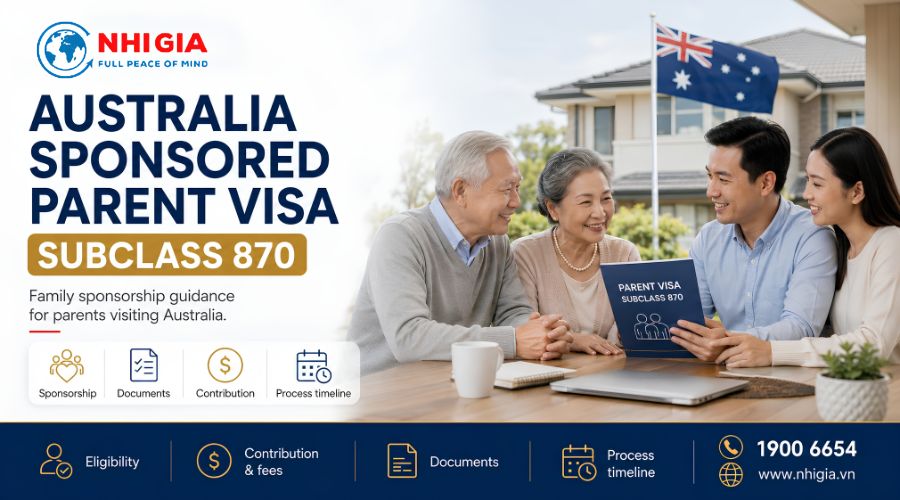
Australia Sponsored Parent Visa subclass 870 is a temporary visa for parents of an Australian citizen, Australian permanent resident or eligible New Zealand citizen to visit Australia and reunite with their children for a longer period than many standard visitor visa options.
According to the Australian Department of Home Affairs, subclass 870 allows parents to stay in Australia for up to 3 years or 5 years, depending on the visa granted. This is a temporary visa, not a permanent residence visa, and it does not automatically lead to Australian permanent residency.
A key feature of the 870 visa is that the process has two stages: first, the child in Australia must be approved as a Parent Sponsor, and only after that can the parent lodge the visa application. Once the sponsor is approved, the visa application must generally be lodged within the required timeframe, usually within 6 months of sponsorship approval.
Who Is the 870 Visa Suitable For?
The 870 visa is suitable for families whose parents wish to stay in Australia with their children for an extended period, but do not yet wish to or do not yet qualify for permanent parent visa pathways.
This visa is usually suitable for cases where:
- Parents want to stay in Australia with their children for 3 or 5 years;
- Families want longer reunion time than a short visitor visa allows;
- The child in Australia meets the Parent Sponsor requirements;
- Parents are not ready to apply for permanent parent visas due to cost, waiting time or eligibility issues;
- The family needs a long-term temporary stay option that matches the purpose of family reunion.
However, the 870 visa is not suitable if the parent wants to work in Australia, settle permanently immediately or include other dependants in the same application. This visa is for the sponsored parent, not a combined family application.
Benefits of the Australia 870 Visa
The 870 visa provides several important benefits for sponsored parents, especially for families who want long-term reunion in Australia.
Main benefits include:
- Temporary stay in Australia for the granted period, usually 3 or 5 years;
- Ability to apply for another 870 visa if still eligible, with a maximum cumulative stay under this pathway of up to 10 years;
- Ability to travel in and out of Australia during the visa validity if the visa conditions allow;
- Longer time to stay close to children and grandchildren, support family life and adapt to Australia;
- No Balance of Family Test requirement, unlike some permanent parent visa categories;
- A temporary option while the family considers other parent visa pathways.
Important note: the 870 visa does not allow work in Australia and is not a permanent residence visa. Visa holders should maintain suitable health insurance during their stay and should not assume they will receive the same healthcare or social security benefits as Australian permanent residents or citizens.
Obligations of the 870 Visa Holder and Sponsor
Sponsor’s Obligations
The sponsor must meet and maintain sponsorship obligations while sponsoring their parent.
In general, the sponsor should note:
- Sponsorship information must be truthful and accurate;
- The sponsor must meet residence status requirements in Australia;
- The sponsor must meet income/financial requirements if applicable;
- The sponsor must not have relevant debts to the Australian Government or must deal with them as required;
- The sponsor should support the parent during their stay in Australia;
- The sponsor must notify the Department of Home Affairs of important changes in circumstances;
- The sponsor must comply with obligations relating to costs if they fall under sponsor responsibility.
If the sponsor no longer meets requirements or withdraws sponsorship, the parent’s visa may be affected. Therefore, sponsorship should be treated as a real legal responsibility, not a formality.
Obligations of the Sponsored Parent
Parents sponsored under the 870 visa must comply with visa conditions and Australian law throughout their stay.
Important obligations include:
- Not working in Australia unless permitted;
- Not staying beyond the visa validity;
- Maintaining suitable health insurance;
- Complying with Australian laws;
- Not incurring unresolved government debts;
- Notifying the Department of Home Affairs of important changes where required;
- Leaving Australia on time or applying for another visa if eligible and allowed.
870 visa holders should pay particular attention to the no work condition. Activities that appear to be “helping family” may still create risks if they amount to work.
Eligibility Requirements for the Australia 870 Visa
Requirements for the Sponsor
Sponsor requirements commonly include:
- Being at least 18 years old;
- Being an Australian citizen, Australian permanent resident or eligible New Zealand citizen;
- Being the biological child, adopted child, stepchild or having a suitable relationship with the sponsored parent as prescribed;
- Meeting Australian residence requirements;
- Meeting income/financial requirements if applicable;
- Having no unresolved Australian Government debts;
- Meeting character requirements;
- Being approved by the Department of Home Affairs as a Parent Sponsor before the parent lodges the visa application.
Requirements for the Sponsored Parent
The sponsored parent usually needs to meet the following requirements:
- Be the parent of an approved sponsor;
- Have an approved sponsorship from the Department of Home Affairs;
- Lodge the visa application within the permitted period after sponsorship approval;
- Meet health requirements;
- Meet character requirements;
- Maintain suitable health insurance during the stay in Australia;
- Have no unresolved Australian Government debts;
- Have no intention to work in Australia;
- Not include dependants in the subclass 870 application;
- Meet other requirements applicable at the time of application.
How Long Is the 870 Visa Valid?
The 870 visa may be granted for 3 years or 5 years, depending on the application option and the decision of the Department of Home Affairs. Parents may apply for another 870 visa if still eligible, but the total stay under this pathway is generally limited to 10 years.
After reaching the maximum stay limit under the 870 visa, the parent must leave Australia or check other visa options if they wish to remain and are eligible. The 870 visa does not automatically convert into permanent residence and is not a direct permanent migration pathway.
What Is the Application Process for the 870 Visa?
Stage 1: The Child Applies to Become an Approved Parent Sponsor
Before the parent lodges the visa application, the child in Australia must apply to become an approved Parent Sponsor. The sponsorship application usually needs to prove the sponsor’s residence status, relationship with the parent, financial capacity, character and other relevant requirements.
If the sponsorship is approved, the sponsor will receive an approval notification. This allows the parent to proceed with the subclass 870 visa application within the permitted timeframe.
Stage 2: The Parent Lodges the 870 Visa Application
After the sponsor is approved, the parent prepares and lodges the 870 visa application online through the Department of Home Affairs system. The dossier must properly show the relationship with the sponsor, purpose of travel to Australia, intended stay period, health, character and health insurance arrangements.
The Department of Home Affairs may request additional documents, health examinations, police checks or other information depending on the application. The visa outcome will be notified according to the Department’s process.
Required Documents for the 870 Visa
Sponsor Documents
- Documents proving Australian citizenship, Australian permanent residence or eligible New Zealand citizen status;
- Documents proving the relationship with the parent;
- Evidence of residence in Australia;
- Income/financial evidence if required;
- Identity documents and police checks where required;
- Information on financial obligations, government debts or related matters if any;
- Sponsorship application forms and required supporting documents.
Sponsored Parent Documents
- Valid passport;
- Birth certificate or documents proving the relationship with the sponsor;
- Identity documents;
- Marriage documents if relevant;
- Evidence of suitable health insurance;
- Police checks if required;
- Health examination documents as instructed;
- Evidence of travel purpose and stay plan;
- Information on finances, accommodation and support in Australia if required;
- Additional documents requested by the Department of Home Affairs.
How Much Does the 870 Visa Cost?
The 870 visa cost includes two main groups: the sponsorship fee paid by the sponsor and the visa application charge paid by the parent under the visa application. The 870 visa charge is usually paid in two instalments: the first when lodging the application and the second when requested by the Department of Home Affairs before visa grant.
The old article states 2024 fees, which should not be reused unchanged for a 2026 update. Australian visa fees may change by financial year and by lodgement date. Therefore, for a 2026 article, the safer wording is: clients should check the official fee at the time of application using the Visa Pricing Estimator or the Department of Home Affairs fee pages. The Department of Home Affairs also provides guidance on visa charges payable in instalments, depending on visa type.
In addition to fees payable to the Department of Home Affairs, families may also incur:
- Health examination fees;
- Police check fees;
- Translation, notarization/certification fees;
- Biometrics fees if required;
- Health insurance costs;
- Service fees if using dossier support;
- Costs for additional documents if requested.
How Long Does the 870 Visa Take to Process?
The processing time for the 870 visa depends on many factors, including application volume, dossier quality, sponsorship completion, additional documents, health examinations, police checks and complexity of the case.
It should not be stated rigidly that “the 870 visa takes 6-8 months” for every application. Australian visa processing times change over time and should be checked using the Department of Home Affairs Global visa processing times tool at the time of application. The Department’s Family Migration page also notes that demand for parent visas is high and some parent visa processing times can be lengthy; subclass 870 is excluded from the queue/cap mechanism of some permanent parent visas but still depends on actual processing.
Can the 870 Visa End Earlier Than Expected?
Yes. The 870 visa may end earlier than expected if circumstances affect visa conditions or sponsorship status.
Cases that may affect the visa include:
- The sponsor withdraws sponsorship;
- The sponsor no longer meets requirements;
- The visa holder breaches visa conditions;
- The visa holder works in breach of visa conditions;
- The visa holder has serious character or legal issues;
- The visa holder fails to maintain suitable health insurance if this condition applies;
- The Department of Home Affairs discovers false information or non-genuine documents in the application.
If the visa is cancelled or expires, the parent must follow the Department’s instructions to leave Australia or manage their visa status lawfully. Overstaying may seriously affect future Australian visa applications.
How Is Visa 870 Different From Visitor Visa Subclass 600?
| Criteria | Visa 870 | Visitor Visa Subclass 600 |
| Purpose | Parents reunite with children in Australia for a longer period | Family visit, tourism or short business visit depending on stream |
| Stay period | Usually 3 or 5 years | Usually shorter, depending on visa grant |
| Separate sponsorship required | Yes, the child must first be approved as a Parent Sponsor | Depends on the case, not always under the 870 sponsorship mechanism |
| Work in Australia | Not permitted | Not permitted |
| Permanent residence | Not a permanent visa | Not a permanent visa |
| Suitable for | Families wanting parents to stay longer in Australia without permanent parent visa yet | Shorter family visits or holidays |
Common Mistakes When Applying for the 870 Visa
Common mistakes include:
- Confusing the 870 visa with a permanent visa;
- Preparing to lodge the parent’s visa before sponsorship is approved;
- Failing to lodge the visa application within the required period after sponsorship approval;
- Not clearly proving the parent-child relationship;
- Sponsor failing to prove residence or financial requirements;
- Parent not having suitable health insurance;
- Incomplete health or character documents;
- Incorrect declarations about visa history, government debts or family status;
- Stating an intention to “help the child work” in the application;
- Using outdated fees or rules without checking the latest updates.
These mistakes may delay the application, trigger additional requests or lead to refusal. Family visas still need logical, well-supported and compliant dossiers.
Australia 870 Visa Support Service by Nhị Gia
Australia 870 visa applications involve multiple steps and require coordination between the sponsor in Australia and the sponsored parent. The dossier must not only prove the family relationship but also meet sponsorship, health, character, health insurance and stay purpose requirements.
With more than 20 years of experience in visa and international dossier support, Nhị Gia assists clients in preparing Australia 870 visa applications based on each specific case.
Nhị Gia supports clients with:
- Advising on 870 visa requirements and suitable parent visa options;
- Checking the sponsor’s eligibility in Australia;
- Guiding sponsorship dossier preparation;
- Reviewing parent-child relationship evidence;
- Guiding visa documents for the parent;
- Checking health insurance, health and character requirements;
- Supporting translation, notarization/certification if needed;
- Reviewing the dossier before submission;
- Tracking application progress and supporting additional requests if any;
- Maintaining confidentiality of clients’ personal and family information.
Nhị Gia does not guarantee visa outcomes for every application, as the final decision belongs to the Australian Department of Home Affairs. However, checking eligibility from the beginning, preparing a clear dossier and avoiding outdated information can help reduce errors and support better family reunion planning.
If you want to sponsor your parent to Australia under the 870 visa or compare the 870 visa with other parent visa options, you should check sponsor eligibility and the parent’s dossier before applying.
Please contact Hotline 1900 6654 or email info@nhigia.vn for detailed support from Nhị Gia’s specialists.