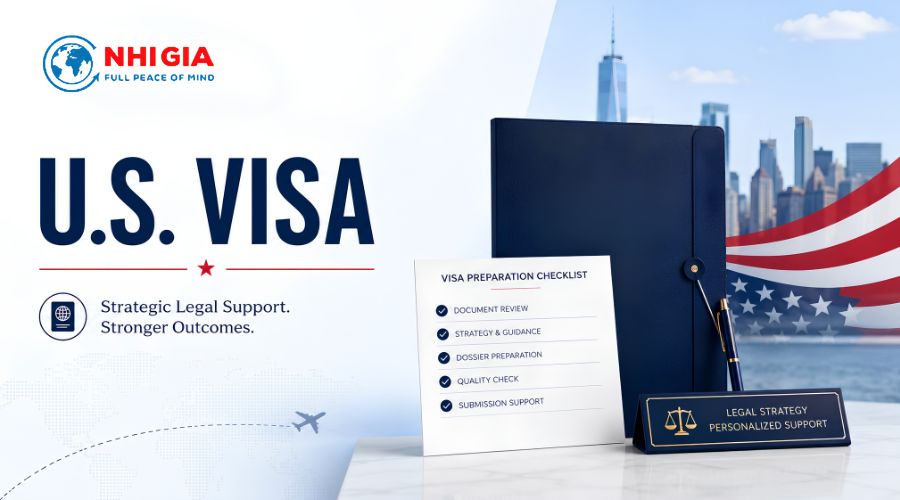
What Is a U.S. Visa?
A U.S. visa is a document issued by a U.S. consular authority, allowing a foreign national to travel to a U.S. port of entry and request admission for the purpose corresponding to the visa category granted. Depending on the purpose of travel, applicants may need to apply for a tourist, family visit, business, student, exchange, investor or immigrant visa.
It should be noted that a U.S. visa does not automatically guarantee entry into the United States or permission to stay for the full visa validity. At the port of entry, the competent U.S. authority will determine admission and the actual period of stay.
For Vietnamese applicants traveling to the United States short-term for tourism, family visits, business or events, nonimmigrant visas, especially B1/B2, are commonly considered. However, the suitable visa category depends on the travel purpose, personal profile and applicable regulations at the time of application.
Common Types of U.S. Visas
U.S. visas are divided into different categories depending on the purpose of entry. Identifying the correct visa category is an important first step before preparing the application because each visa type has its own requirements, forms and review process.
Common U.S. visa types include:
| Visa type | Main purpose |
| U.S. tourist visa | For applicants traveling to the U.S. for tourism, vacation, sightseeing or suitable short-term personal activities |
| U.S. family visit visa | For applicants visiting relatives, friends or attending suitable family occasions in the U.S. |
| U.S. business visa | For applicants traveling to the U.S. for meetings, partner visits, conferences, seminars or suitable short-term business activities |
| U.S. student visa | For students or participants in academic programs at approved educational institutions |
| Exchange visa | For participants in suitable exchange, training or sponsored programs |
| Investor/business visa | For certain investment, business or commercial activity cases meeting applicable requirements |
| U.S. immigrant visa | For applicants with immigrant petitions, family reunification, employment-based immigration or other immigrant categories |
Nhị Gia supports clients in identifying the suitable visa direction based on each specific travel purpose before starting the application process.
What Documents Are Required for a U.S. Visa Application?
U.S. visa documents vary depending on visa category, travel purpose, personal situation, employment, financial capacity, travel history and requirements at the time of application. For nonimmigrant visas such as tourism, family visit or business, applicants commonly prepare the following document groups:
Personal Documents
- Passport valid for the intended U.S. travel plan;
- Previous passports if any;
- DS-160 confirmation page;
- Interview appointment confirmation;
- U.S. visa photo meeting requirements if required for submission or interview;
- Citizen ID card or other identity documents if needed for cross-checking;
- Birth certificate, marriage certificate or relevant civil status documents if relationship proof is required.
Employment or Study Documents
Depending on the applicant’s status, documents may include:
- Employment contract;
- Employment confirmation letter;
- Leave approval letter or leave confirmation;
- Payslips, salary bank statements or income documents;
- Business registration certificate, business documents or tax records if the applicant owns a business;
- Student card, enrollment confirmation or related documents if the applicant is a student;
- Retirement documents if the applicant is retired.
Financial and Asset Documents
Financial documents help demonstrate the applicant’s ability to cover the trip and financial situation in Vietnam. Depending on the case, documents may include:
- Bank statements;
- Savings book or balance confirmation;
- Property ownership documents if any;
- Vehicle registration or other valuable asset documents if relevant;
- Income records, dividends, rental income or other lawful income sources;
- Financial documents of the sponsor if the trip is financially sponsored.
Travel Documents
Depending on the travel purpose, the applicant may prepare:
- Intended itinerary in the United States;
- Invitation letter if visiting family, traveling for business or attending an event;
- Information of relatives, friends, partners or inviting organizations in the U.S. if any;
- Documents proving the travel purpose;
- Intended accommodation information;
- Plan to return to Vietnam after the trip.
Applicants should be cautious about purchasing non-refundable flight tickets or hotel bookings before obtaining the visa result. In many cases, an intended itinerary and accommodation information may be prepared to explain the travel purpose, but purchased tickets or hotel bookings should not be considered a guarantee of visa approval.
U.S. Visa Application Process
The U.S. visa application process may vary by visa category, but for nonimmigrant visas, it commonly includes the following basic steps:
Step 1: Identify the Suitable Visa Category
Before applying, the applicant should clearly identify the travel purpose to select the suitable visa category. Choosing the wrong visa category may cause the application to not properly reflect the entry purpose and affect the review process.
Step 2: Complete the DS-160 Form
For nonimmigrant visas, the applicant must complete the DS-160 form online. Information in the DS-160 must be accurate and consistent with the passport, personal records, travel history, travel purpose and supporting documents.
After completion, the applicant should save and print the DS-160 confirmation page for appointment scheduling and the interview.
Step 3: Pay the Fee and Schedule an Appointment
After completing the DS-160, the applicant proceeds with visa fee payment and interview appointment scheduling according to the appointment system instructions. Appointment availability depends on available slots at the time of scheduling and the relevant visa category.
Step 4: Prepare Documents for the Interview
Before the interview, the applicant should review personal, employment, financial, travel purpose, intended itinerary and related documents. Documents should be organized clearly so they can be presented when requested.
Step 5: Attend the Interview at the U.S. Consular Post
The applicant attends the interview at the U.S. Embassy in Hanoi or the U.S. Consulate General in Ho Chi Minh City, depending on the scheduled location. During the interview, the applicant should answer truthfully, clearly and consistently with the information declared in the DS-160.
Step 6: Receive the Result and Passport
After the interview, if the application is approved, the passport with visa will be returned through the selected delivery method. Some applications may require additional administrative processing or further information as requested by the consular authority.
Where Is the U.S. Visa Interview Conducted?
Applicants in Vietnam commonly schedule interviews at one of the following locations, depending on the application type and appointment availability:
- U.S. Embassy in Hanoi
170 Ngoc Khanh, Ba Dinh, Hanoi - U.S. Consulate General in Ho Chi Minh City
4 Le Duan, District 1, Ho Chi Minh City
Interview location, entry procedures, security requirements, documents to bring and passport return method may change according to official instructions from time to time. Applicants should check the information before the interview date to avoid mistakes.
How Long Does a U.S. Visa Application Take?
The U.S. visa application timeline should not be understood as a fixed period for all cases. The actual total timeline may depend on visa category, interview appointment availability, document preparation time, the applicant’s personal situation, additional information requests and whether administrative processing is required.
In general, the process may include:
- Consultation and identifying the suitable visa category;
- DS-160 completion time;
- Fee payment and appointment scheduling time;
- Waiting time until the interview date;
- Post-interview processing time if approved;
- Passport delivery time;
- Additional administrative processing time if applicable.
Nhị Gia will advise the estimated timeline after reviewing the client’s needs, visa category and specific dossier status. A fixed processing time should not be guaranteed before checking the dossier and actual appointment availability.
Validity of a U.S. Visa
The validity of a U.S. visa depends on visa category, applicant nationality, reciprocity rules and the decision of the U.S. consular authority. For certain common nonimmigrant visas, the visa may be issued with a specific validity and number of entries.
It is important to distinguish between visa validity and authorized period of stay in the United States. Visa validity is the period during which the applicant may use the visa to request admission to the United States. The authorized period of stay after each entry is determined by the competent U.S. authority at the port of entry.
Therefore, applicants should not assume that they may stay in the United States for the entire visa validity period. The stay must comply with the authorized period granted upon entry and related regulations.
Tips for Preparing for a U.S. Visa Interview
The interview is an important step in the U.S. visa application process. Applicants should prepare information and documents carefully to answer clearly, truthfully and consistently.
Some interview preparation tips include:
- Understand the travel purpose and intended plan in the United States;
- Answer truthfully, directly and consistently with the information declared in the DS-160;
- Organize personal, employment, financial and travel documents for easy reference;
- Be ready to explain the plan to return to Vietnam if asked;
- Do not provide false information or inaccurate documents;
- Do not memorize answers mechanically; applicants should understand their own profile;
- Arrive on time according to the appointment and follow security instructions at the consular post.
Visa results depend on the consular officer’s assessment based on the application, declared information, interview content and applicable regulations. No service provider can guarantee visa approval.
Possible Reasons for U.S. Visa Refusal
A U.S. visa application may be refused for various reasons depending on visa category, personal situation and the consular officer’s assessment. Common reasons include:
- Travel purpose is not clear;
- Application documents are inconsistent with DS-160 information;
- The applicant does not demonstrate eligibility for the requested visa category;
- The plan to return to Vietnam after the trip is not clearly shown;
- Financial, employment or personal ties are not sufficiently persuasive;
- Travel history or visa history requires further explanation;
- Interview answers are inconsistent or not aligned with the dossier;
- Inaccurate information or unsuitable documents are provided;
- The application requires additional administrative processing.
If a U.S. visa is refused, the applicant should review the refusal reason, reassess the dossier, address unsuitable points and reapply only when there is a basis for improvement. Reapplying immediately without meaningful changes may not improve the chance of approval.
Should Applicants Apply for a U.S. Visa Independently?
Applicants may apply for a U.S. visa independently if they understand the required visa category, know how to complete the DS-160, can prepare suitable supporting documents and feel confident attending the interview.
However, in some cases, professional consultation may help reduce errors, for example:
- The suitable visa category is unclear;
- The applicant has previously been refused a U.S. visa or visas of other countries;
- Employment, financial or travel history requires explanation;
- Family visit, business or financial sponsorship cases involve multiple parties;
- The applicant is not confident in completing the DS-160;
- Documents require translation, notarization or clearer organization;
- Interview preparation guidance is needed based on the actual profile.
Using a consulting service does not replace the decision of the consular authority and does not guarantee visa approval. However, preparing a complete dossier, maintaining consistent information and understanding the travel purpose can help the applicant be more proactive during the application process.
U.S. Visa Consulting Service by Nhị Gia
U.S. visa applications must be prepared carefully because they involve personal information, travel history, employment, finances, travel purpose and the interview with a consular officer. If declared information is inconsistent or the dossier does not properly reflect the travel purpose, the review process may be affected.
With experience in visa, work permit, temporary residence card, entry approval and legal dossiers for individuals and enterprises, Nhị Gia supports clients in preparing U.S. visa applications based on each specific case.
Nhị Gia supports clients with:
- Advising on the suitable U.S. visa category based on travel purpose;
- Reviewing personal, employment, financial and travel history documents;
- Guiding preparation of documents proving travel purpose;
- Guiding DS-160 completion based on information provided by the client;
- Supporting information consistency checks;
- Guiding fee payment, appointment scheduling and interview preparation;
- Advising on document organization for interview convenience;
- Supporting review of previously refused applications if the client wishes to reapply;
- Advising on related procedures such as translation, notarization/certification, family visit documents, business documents or financial documents if needed;
- Maintaining confidentiality of personal information and client dossiers.
Nhị Gia does not guarantee visa results, as the decision to issue or refuse a visa belongs to the competent U.S. consular authority. However, preparing a clear dossier, maintaining consistent information and correctly understanding the travel purpose can help clients be more proactive during the procedure.
Nhị Gia Support Process for U.S. Visa Applications
The support process at Nhị Gia focuses on reviewing the dossier first, advising on a suitable approach and helping clients prepare information based on each specific case.
- Step 1: Information Collection. Nhị Gia collects information about travel purpose, intended travel time, personal status, employment, finances, travel history and inviter or inviting organization in the U.S. if any.
- Step 2: Visa Category and Dossier Direction Consultation. Nhị Gia advises on the suitable visa category, document groups to prepare and key points to note based on the client’s actual profile.
- Step 3: Document and DS-160 Preparation Guidance. Nhị Gia guides clients in preparing documents, reviewing information required for DS-160 and checking consistency among documents, travel purpose and personal information.
- Step 4: Appointment and Interview Preparation Support. Nhị Gia guides the fee payment process, appointment scheduling and document preparation before the interview date. Clients are advised on how to present information clearly, truthfully and consistently with their actual dossier.
- Step 5: Result Follow-Up and Next-Step Consultation. After the interview, Nhị Gia guides clients in result tracking, passport collection or preparation of additional information if requested by the consular authority. If the application is refused, Nhị Gia may support dossier review and advise on a more suitable preparation direction for a future application.
If you need to apply for a U.S. visa for tourism, family visit, business, study, investment or immigration, the suitable visa category, dossier conditions and travel plan should be reviewed before submission.
Please contact Hotline 1900 6654 or email info@nhigia.vn for case-specific consultation from Nhị Gia’s specialists.