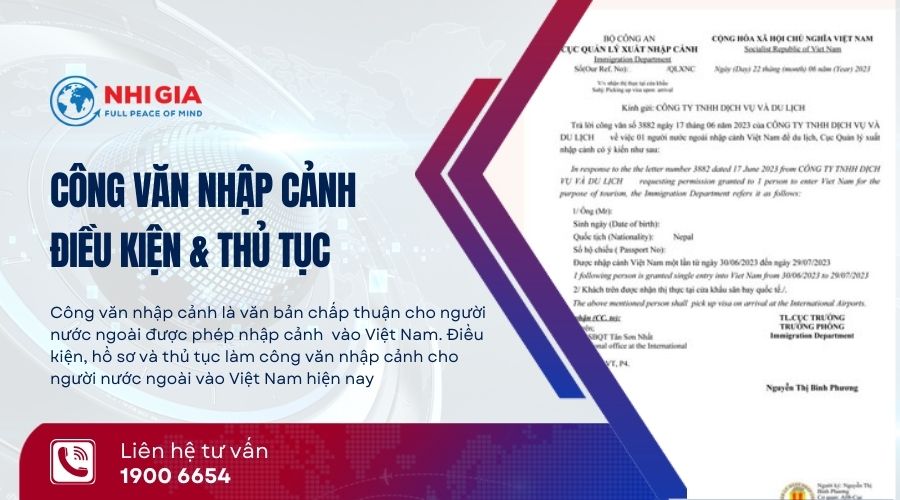
What Is a Vietnam Entry Approval Letter?
Vietnam entry approval letter is a written response from the competent immigration authority regarding personnel assessment, verification and permission for a foreign national to enter Vietnam under the sponsorship of an agency, organization or individual in Vietnam.
The entry approval letter is commonly used for the foreign national to receive a Vietnam visa at a competent Vietnamese visa-issuing authority overseas or at an international border gate according to the approved content.
It is important to distinguish that an entry approval letter is not a visa. It is an approval or response allowing the foreign national to receive a visa under a sponsorship arrangement. After obtaining the entry approval letter, the foreign national still needs to complete visa issuance procedures at the approved location, within the approved validity, entry type and purpose.
Other Names for Vietnam Entry Approval Letter
In practice, a Vietnam entry approval letter may also be referred to by different names, such as:
- Entry permission letter;
- Entry approval letter;
- Entry request letter;
- Sponsorship letter for entry;
- Invitation letter for entry;
- Vietnam approval letter;
- Vietnam entry approval;
- Vietnam entry permit.
However, for legal and immigration procedures, enterprises and foreign nationals should rely on the official form, approval content and guidance of the immigration authority to avoid confusion among entry approval letter, visa, temporary residence card and other residence documents.
What Information Is Included in an Entry Approval Letter?
A Vietnam entry approval letter usually contains information about the foreign national, the sponsor and the approved entry content.
Common information includes:
- Full name of the foreign national;
- Date of birth;
- Nationality;
- Passport number;
- Information of the inviting/sponsoring agency, organization or individual;
- Entry purpose;
- Expected entry date;
- Visa validity to be considered;
- Number of entries if stated;
- Visa receiving location in Vietnam or overseas;
- Entry border gate if visa-on-arrival at an international border gate is approved;
- Other information according to the authority’s assessment result.
For applications sponsored by agencies or organizations, the commonly used form is Form NA2. For cases where an individual sponsors a foreign relative to enter Vietnam, the commonly used form is Form NA3 under the corresponding procedure.
Requirements for Vietnam Entry Approval Letter
To apply for a Vietnam entry approval letter for a foreign national, the dossier must meet basic requirements under Vietnam’s regulations on entry, exit, transit and residence of foreigners. Consolidated Document 62/VBHN-VPQH in 2026 is the current consolidated legal framework in this field.
Common requirements include:
- The foreign national has a valid passport or international travel document;
- There is an agency, organization or individual in Vietnam inviting or sponsoring the foreign national;
- The entry purpose is consistent with the intended visa type;
- The foreign national does not fall under cases of entry suspension under Vietnamese law;
- The sponsoring entity has suitable legal documents and authority to invite/sponsor;
- The entry approval application is completed fully, accurately and in the correct form.
Some cases require documents proving the entry purpose, such as:
- Investors need documents proving investment activities in Vietnam;
- Lawyers practicing in Vietnam need a practicing license as prescribed;
- Workers need a work permit or work permit exemption confirmation if applicable;
- Students need an acceptance letter from a school or educational institution in Vietnam.
Cases of Entry Suspension Into Vietnam
A foreign national may be suspended from entry into Vietnam if falling under cases prescribed by current law.
Common cases include:
- Not meeting entry conditions as prescribed;
- Children under 14 years old not accompanied by parents, guardians or authorized persons;
- Forging documents or making false declarations to obtain entry, exit or residence documents;
- Having an infectious disease dangerous to public health;
- Having been expelled from Vietnam within the restricted period;
- Having been forced to exit Vietnam within the restricted period;
- For epidemic prevention and control reasons;
- For natural disaster reasons;
- For national defense, security, social order and safety reasons.
Therefore, before applying for an entry approval letter, the sponsoring enterprise or individual should review the foreign national’s personal information, entry history, entry purpose and related documents.
Types of Vietnam Entry Approval Letter
By Entry Purpose
Depending on the case, an entry approval letter may serve purposes such as:
- Business trip or working with enterprises in Vietnam;
- Employment;
- Investment;
- Family visit;
- Study;
- Tourism under sponsorship;
- Conferences or seminars;
- Other suitable purposes as prescribed.
By Visa Receiving Location
The foreign national may be approved to receive the visa at:
- A Vietnamese representative mission overseas;
- An international border gate;
- An international airport in Vietnam;
- Another location stated in the approval letter.
By Validity and Number of Entries
Validity and number of entries depend on entry purpose, visa type, sponsorship dossier and the decision of the competent authority. It should not be understood that entry approval letters are always issued for a fixed validity period in all cases.
In practice, visas may be considered under groups such as:
- Single entry;
- Multiple entries;
- Short-term or longer validity depending on visa type and dossier conditions;
- Visa categories with specific validity such as DN, LĐ, ĐT, TT, DL, DH and other symbols as prescribed.
Required Documents for Vietnam Entry Approval Letter
Entry approval documents may vary depending on entry purpose, type of sponsor, the foreign national’s current location, visa receiving location and intended visa type.
In general, documents should be prepared under the following groups:
Information and Documents of the Foreign National
- Full name;
- Date of birth;
- Nationality;
- Passport number;
- Color scan of the passport data page;
- Expected entry date;
- Expected exit date;
- Vietnam visa receiving location;
- Expected entry border gate;
- Entry purpose;
- Intended address of stay in Vietnam;
- Documents proving entry purpose if required.
Documents of the Sponsoring Agency or Organization
For agencies, organizations or enterprises in Vietnam inviting or sponsoring foreign nationals, the dossier commonly includes:
- Request for personnel assessment/verification for foreigner’s entry using Form NA2;
- Legal documents of the sponsoring enterprise, agency or organization;
- Seal and signature introduction form if not previously registered or if there are changes;
- Documents proving the corresponding entry purpose;
- Electronic transaction account or registration information if applying online;
- Introduction letter or authorization for the person submitting the dossier if submitted directly;
- Additional documents required by the immigration authority.
Documents of an Individual Sponsoring a Foreign Relative
For cases where an individual in Vietnam sponsors a foreign relative to enter Vietnam, the dossier usually needs additional review of:
- Sponsorship application for foreign relative’s entry using Form NA3;
- Documents proving family relationship;
- Identity documents of the sponsor;
- Passport information and entry schedule of the foreign national;
- Intended address of stay in Vietnam;
- Additional documents required by the competent authority.
Vietnam Entry Approval Letter Application Process
The process for obtaining an entry approval letter may be completed directly or electronically depending on the case and the sponsor’s eligibility. According to the Ministry of Public Security public service portal, agencies and organizations may carry out procedures through the immigration e-portal or public service portal to check results; if entry is approved, they inform the foreign national to receive the visa at a competent Vietnamese visa-issuing authority overseas or at an international border gate.
The basic process includes:
Step 1: Check Entry Purpose and Suitable Visa Type
The sponsor should clearly identify the foreign national’s entry purpose, expected stay duration, visa receiving location and whether single or multiple entries are needed.
Correctly identifying the entry purpose helps determine the suitable visa type and prepare the proper supporting documents.
Step 2: Prepare Sponsorship Dossier
The sponsoring agency, organization, enterprise or individual prepares the dossier according to the specific case, including forms, foreign national’s information, legal documents of the sponsor and documents proving entry purpose.
Step 3: Submit the Application to the Competent Authority or Online System
Depending on the conditions and method, the dossier may be submitted to the competent immigration authority or through the electronic transaction system.
The receiving authority will review the dossier and may request supplementation or correction if the application is incomplete or unsuitable.
Step 4: Track Application Result
The sponsor tracks the processing result through the system or according to the receiving authority’s guidance. If approved, the sponsor receives the written response and sends the information to the foreign national.
Step 5: Foreign National Receives Vietnam Visa
After the entry approval letter is issued, the foreign national proceeds with visa issuance at the approved location, which may be a Vietnamese representative mission overseas or an international border gate.
When receiving the visa, the foreign national usually needs to prepare:
- Original passport;
- Photos in the required format if requested;
- Visa application form according to the suitable template;
- Printed entry approval letter;
- Visa issuance fee as prescribed.
Where to Submit a Vietnam Entry Approval Letter Application
Entry approval applications are usually submitted to the competent immigration authority or through an online system if conditions are met.
Depending on the case, the sponsoring agency, organization or individual may carry out the procedure at:
- Vietnam Immigration Department;
- Immigration Division of the provincial/city police;
- Ministry of Public Security public service portal;
- National public service portal;
- Immigration e-portal.
Because receiving locations, submission methods and processing scope may vary by application type, the sponsor should check current information before proceeding.
Vietnam Entry Approval and Visa Issuance Fees
When preparing an entry approval application, it is necessary to distinguish among:
- Fees or costs related to preparing and handling the entry approval dossier;
- Visa issuance fees paid when the foreign national receives the Vietnam visa;
- Other costs such as translation, notarization/certification, consular legalization, courier, travel or dossier support service fees.
Visa issuance fees depend on visa type, validity and number of entries. From 1 April 2026, Circular 28/2026/TT-BTC of the Ministry of Finance takes effect, regulating fees and charges in the field of exit, entry, transit and residence in Vietnam.
Common visa issuance fees include:
| Visa type | Reference fee |
| Single-entry visa | USD 25 per visa |
| Multiple-entry visa, valid for up to 90 days | USD 50 per visa |
| Multiple-entry visa, over 90 days to 180 days | USD 95 per visa |
| Multiple-entry visa, over 180 days to 01 year | USD 135 per visa |
| Multiple-entry visa, over 01 year to 02 years | USD 145 per visa |
| Multiple-entry visa, over 02 years to 05 years | USD 155 per visa |
| Visa issued to persons under 14 years old, regardless of validity | USD 25 per visa |
Paid fees and charges are generally non-refundable if the application does not meet conditions for issuance or if the applicant refuses to receive the processing result, unless otherwise provided by law.
Processing Time for Vietnam Entry Approval Letter
Processing time for a Vietnam entry approval letter depends on the submission method, application type, entry purpose, sponsoring entity’s dossier status, foreign national’s nationality, visa receiving location and additional requests if any.
The statutory processing time should not be understood as the entire actual timeline when clients use dossier support services. In practice, the total timeline may include:
- Consultation and identifying the suitable visa type;
- Reviewing legal documents of the sponsoring entity;
- Checking passport information and entry purpose;
- Preparing forms;
- Standardizing documents;
- Submitting the dossier;
- Tracking results;
- Receiving the entry approval letter;
- Coordinating for the foreign national to receive the visa at the approved location.
Nhị Gia will advise the estimated timeline after reviewing the specific dossier. Fixed processing time should not be guaranteed for all cases before the dossier has been fully reviewed.
Common Challenges When Applying for an Entry Approval Letter Independently
When applying independently, the sponsoring enterprise or individual may encounter challenges such as:
- Not identifying the correct visa type or entry purpose;
- Not preparing the correct Form NA2, NA3 or related documents;
- Incomplete legal documents of the sponsoring entity;
- Unclear documents proving entry purpose;
- Inconsistency in passport information, entry date, visa receiving location or entry border gate;
- Uncertainty about direct or online submission methods;
- Receiving additional document requests without knowing how to properly revise the dossier;
- Spending additional time tracking progress and coordinating with the foreign national;
- Difficulty staying proactive when the entry plan is urgent.
These issues may extend processing time or affect the foreign national’s entry plan. Therefore, the dossier should be carefully reviewed before submission.
Vietnam Entry Approval Letter Support Service by Nhị Gia
Vietnam entry approval letter is an important dossier in the Vietnam visa process under invitation or sponsorship for foreign nationals. The application must be prepared with the correct entry purpose, proper forms, accurate passport information and consistency with the sponsoring entity’s legal dossier.
With more than 20 years of experience in Vietnam visas, entry approval letters, work permits, temporary residence cards and legal dossiers for foreigners in Vietnam, Nhị Gia supports enterprises, organizations, individuals and foreign nationals in preparing applications based on each specific case.
Nhị Gia supports clients with:
- Advising on the suitable visa type and entry purpose;
- Checking passport information, entry schedule and visa receiving location;
- Reviewing legal documents of the sponsoring entity;
- Guiding preparation of Form NA2, Form NA3 or suitable forms;
- Guiding preparation of documents proving entry purpose;
- Supporting dossier standardization before submission;
- Tracking application status;
- Supporting additional document requests if any;
- Guiding the foreign national to receive the visa at the approved location;
- Advising on related procedures such as visa extension, work permit, temporary residence card, police record and consular legalization if needed;
- Maintaining confidentiality of personal information, enterprise dossiers and client documents.
Nhị Gia does not guarantee outcomes for every application, as the final decision belongs to the competent authority. However, identifying the correct entry purpose, preparing a complete dossier and checking information consistency from the beginning can help reduce errors and support a more proactive Vietnam entry plan.
Nhị Gia Support Process for Entry Approval Letter
The support process at Nhị Gia focuses on reviewing the dossier first, advising on the suitable handling direction and tracking progress based on each specific case.
- Step 1: Information Collection. Nhị Gia collects information about the foreign national, sponsoring entity, entry purpose, expected entry date, stay duration, visa receiving location and related needs.
- Step 2: Dossier Review and Consultation. Nhị Gia reviews passport information, legal documents of the sponsor, entry purpose and required documents. After review, Nhị Gia advises on the suitable application direction for each case.
- Step 3: Dossier Preparation and Standardization. Nhị Gia supports form preparation, information review, document supplementation guidance and dossier standardization before submission to the competent authority.
- Step 4: Submission and Result Tracking. Nhị Gia supports submission through the suitable method and tracks processing status. If additional documents are requested, Nhị Gia coordinates with the client to prepare the required revisions.
- Step 5: Result Delivery and Visa Issuance Guidance. After the result is available, Nhị Gia delivers the entry approval letter and guides the foreign national in preparing the required documents to receive the visa at the approved location.
Nhị Gia Service Timeline
The statutory processing time refers to the processing period of the competent authority after receiving a complete and valid dossier. It is not the entire actual timeline when clients use Nhị Gia’s service.
When using Nhị Gia’s service, the actual timeline depends on the sponsoring entity’s dossier status, passport information of the foreign national, entry purpose, submission timing, submission method, visa receiving location, additional requests if any and immigration authority processing progress.
Nhị Gia will advise the estimated timeline after reviewing the client’s specific dossier.
Contact Nhị Gia for Vietnam Entry Approval Letter Consultation
If you are an enterprise, organization or individual needing to invite or sponsor a foreign national to enter Vietnam, you should check the correct entry purpose, visa type and legal dossier before proceeding.
Please contact Hotline 1900 6654 or email info@nhigia.vn for case-specific consultation from Nhị Gia’s specialists.